Getting Back into DIY Mode with 3 Simple Home Updates

It finally feels like spring is here. Trees are blooming, weather is warming, and I feel like I am coming out of a hibernation of sorts. Lately I’ve been feeling the urge to get back into DIY projects around the house – my inspiration to create is coming back! There was a time where I was cranking out project after project, room after room. It wasn’t a sustainable pace, and my desire to tackle projects around our house dipped. I chose to focus on other things within our family and with other commitments in our school, church, and community and now I feel like I have a good balance and am ready to add projects back into the mix.

I decided to jump back into things with three quick and easy projects. A couple of them are so quick and easy that project may even be too big a term. Call them updates, call them tasks – whatever they are, they’re simple to do yet make a big impact and were the perfect things to get my momentum rolling back into DIY around the house so today I’m going to share them with you.

A Sweet and Simple Vanity

My five year old daughter loves to dress up. She loves doing her hair and putting on simple make-up (which at this point is basically just lip balm) and she loves to accessorize. She had created her own little “vanity” area using a chair and a jewelry box with a mirror but it was spilling out and taking over a ton of floor space. Since she shares the room with her older brother, we really needed to find a better solution. I wanted low-budget and small footprint because this is a shared space and relatively short-term; she will eventually be moving into her own room, currently the nursery, and the boys will eventually share this room.

I grabbed a 2 x 4, approximately 27.5 inches long, from our stash of scrap wood to create a little vanity shelf. It was already stained, so I could eliminate that step. I also pulled out two L-brackets and some screws (we already had all these on hand, but they’re all simple, inexpensive supplies to pick up at a home-improvement store). I didn’t want to mess with using anchors, so I used our stud finder to locate the studs and screwed the brackets directly into them.

I shopped my house and collected a small mirror (originally thrifted for $1!) to hang with command strips and a few little trays and containers to see what would fit on the shelf. I tinkered around a bit until I settled on a combination that felt cute, functional, and easy for a five-year-old to maintain.

This was the perfect little project to jump back into DIY: quick, simple, and thanks to using all supplies we had on hand, zero dollars!

My daughter LOVES her new little vanity and uses it every day to get ready!

Faux Plants + Brass Planters

When I hung this collection of vintage brass wall planters in my son’s nursery, I attempted to plant a few live plants. And it looked great . . . at first.

I tried to pick low-maintenance plants with a tolerance for low light, but the reality is the room is dim. It’s nearly impossible to photograph accurately in natural light. It’s north-facing, there’s a ton of trees in our backyard, there’s only one window, and it just doesn’t bring in enough light for plants. After cycling through a few different plant attempts and all of them dying, I finally gave up and decided to go all faux.
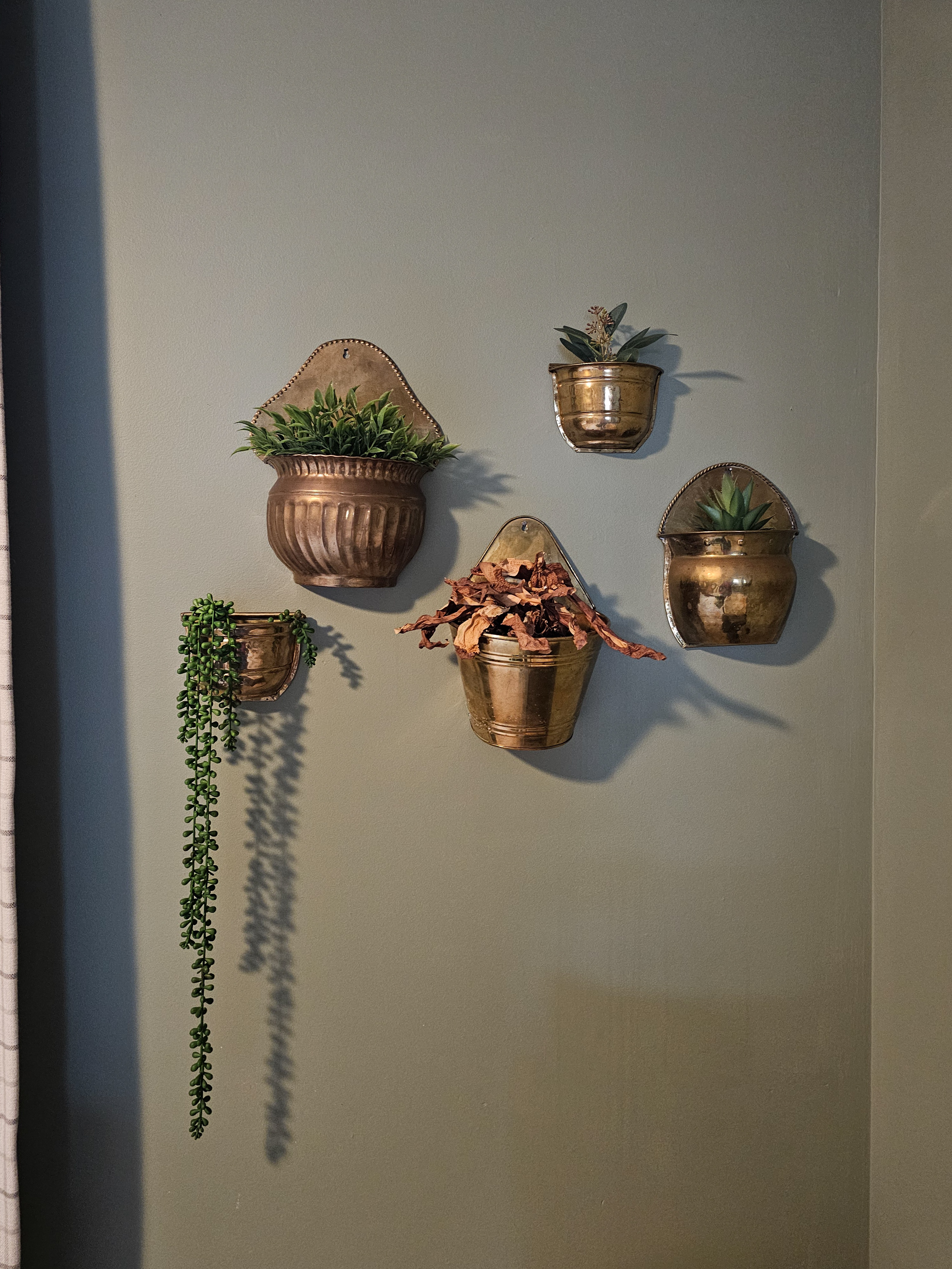
I was able to shop my house for 4 different faux plants, but was stuck on the largest planter. I didn’t have anything that worked for it but also didn’t want to buy something brand new. I’m really trying to have a more conscious, smaller consumer footprint when I can and so I wanted to thrift and give new, well, life to a discarded faux plant. It took a couple months on my thrift list before I finally came across a plant that would work, but it was worth the wait (and staring at the dead plant for months, ha!)
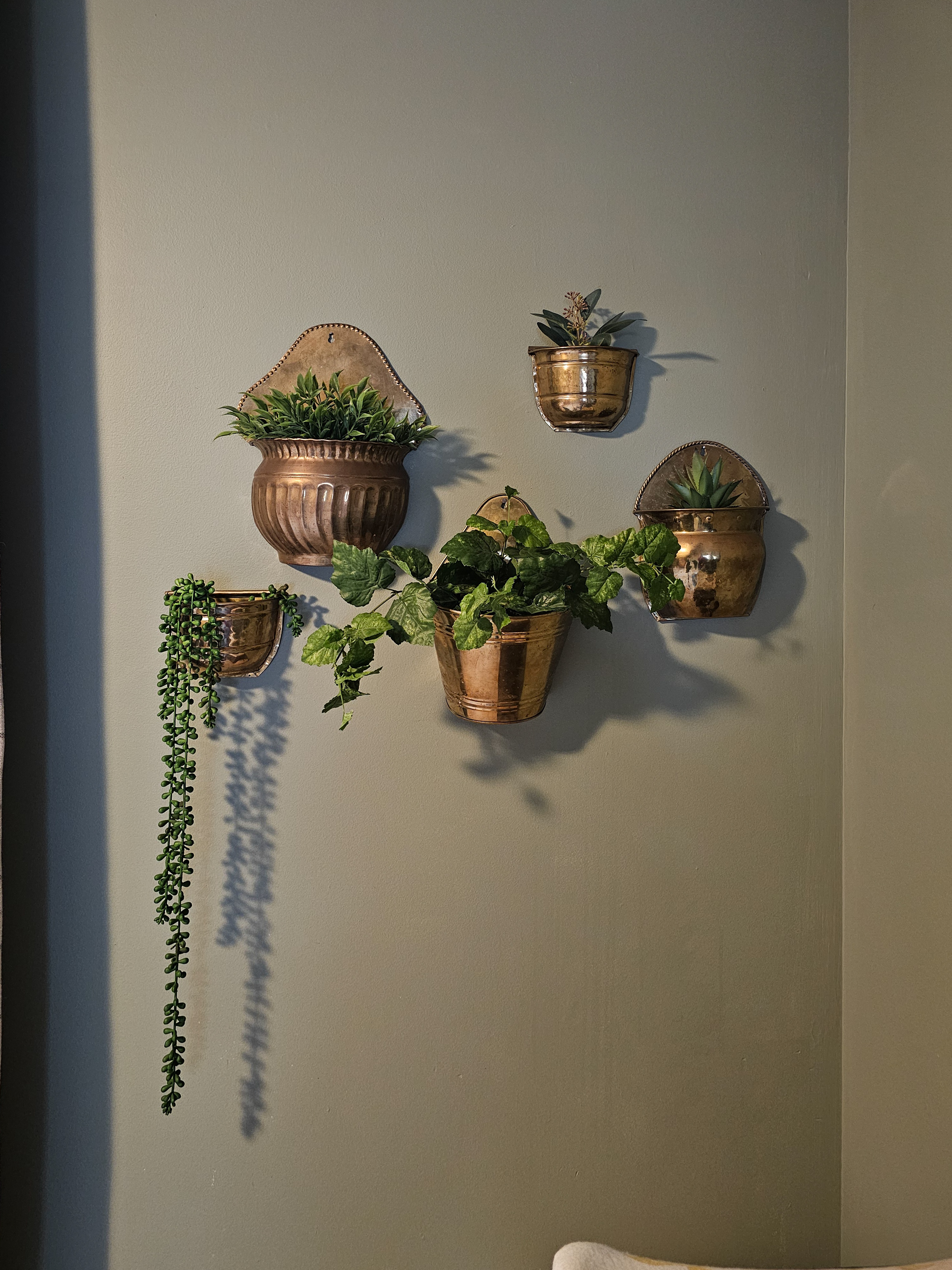
Bonus: I was able to snip a few branches off to use in my planter and it didn’t impact the overall look of the original plant so I was able to re-donate it and hopefully someone else will also find use for it!

Picture Grid in the Hallway

We had our foyer and hallway painted in December 2023 and ever since, I have wanted to get some family photos up in the hallway. I often do a mixed-material gallery wall but this time I wanted to do a black and white grid of frames.

And so began a 16+ month “project” that really could’ve been done in one day. I had been brainstorming since December 2023, used painters tape to tape off grid ideas in February 2024, then in April 2024 I cut packaging paper into squares and hung up different configurations of sizes and number of frames to visualize.
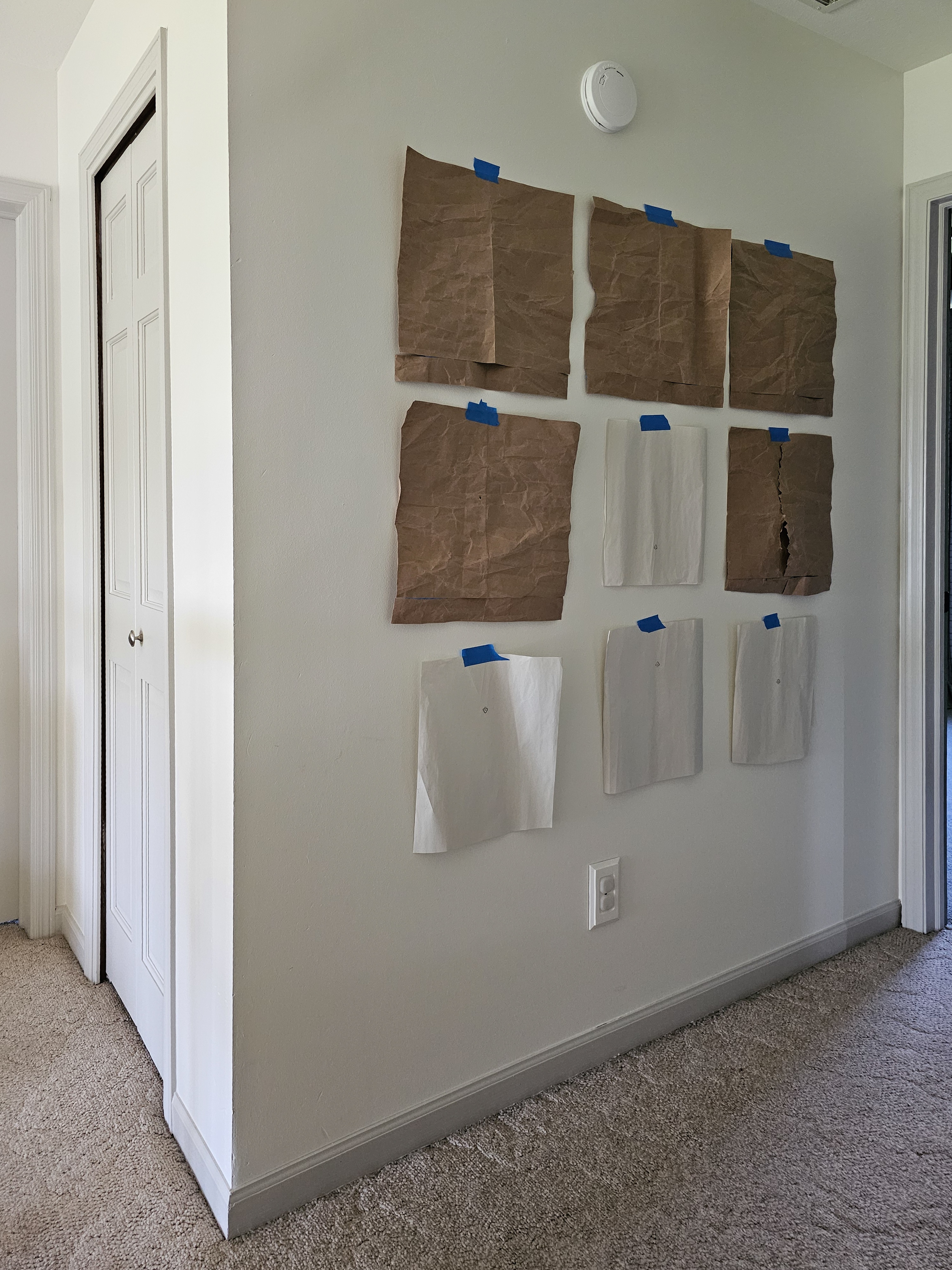
These papers hung in my hallway for four months until I finally bought frames in August 2024, and those frames sat propped against the wall in my hallway until April 2025. I’m glad I took the time to really think and plan what I wanted rather than just throwing something up on the walls – this was a good reminder that sometimes it takes time to figure out exactly what you want and that’s okay. But also…once I figured it out and bought the supplies, I definitely procrastinated. I was intimidated to hang a grid knowing the precision needed is different than my normal method, and also it took me a while to choose the pictures I wanted to use.

I finally made myself carve out the time to do the last few steps and surprise surprise, it didn’t actually take that long to install. I used a laser level and that was such a game changer. This is key: I did not align the laser level with the top of the frame! Instead I held the frame where I wanted it, then brought one side away from the wall to see where the sawtooth hangers were and aligned the laser level line with them.

It did take me a while to measure and mark out where every single nail hole was going to go, but it was well worth the effort to check and double-check measurements. It then took no time at all to actually hammer in the nails and hang the frames and thanks to all that measuring, they aligned perfectly!
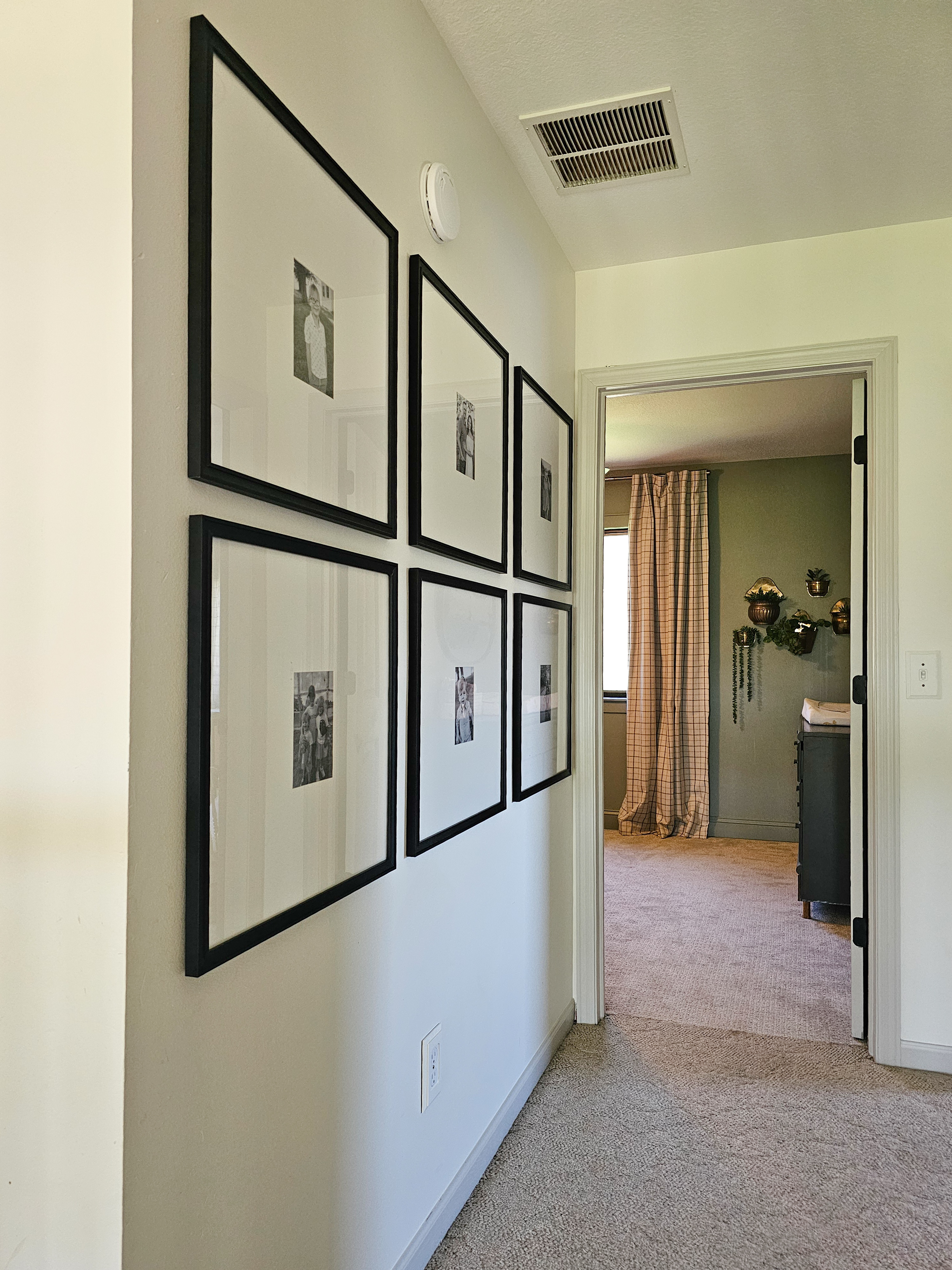
I’m so glad this task is checked off my list and I love seeing the frames in the hallway! Maybe this can be your sign that the thing you’re putting off might not actually be that bad or take that long, so just do it! šŸ˜‰

Each of these three projects is pretty small on their own, but they make a big impact in their individual spaces. And bonus – they are all basically next to one another in the house so the overall impact of seeing the three together packs a big punch!

It’s just what I needed to get back into the swing of things and now I’m looking forward to some bigger projects.

Coming Up in May…

A few of the projects I’m going to tackle this month:

1 – Last year we did a huge patio renovation and this month we’re going to continue to upgrade the space.

2 – Finish the living room. This is another space that has been a long time coming and I finally have the inspiration and motivation to finish it up!

3 – Start our biggest renovation to date. This has been years in the making. It’s multi-room. It’s a full gut job. We’re hiring out a lot of the work because of the scope of the job. It’s so exciting for Justin and I and is going to hugely improve functionality for our family. I’m keeping it a tiny bit secretive for now but a hint for long-time followers is it involves a couple rooms that I did surface-level updates to several years ago (one in the very early days of my DIY home projects) to tide us over until full renovations could occur. Plans are almost finalized and I can’t wait to share, but until then I’d love to hear your guesses šŸ™‚

Fresh Artwork + Pillows in the Living Room

This week I made some more progress in the living room with a few small changes that made a big impact.

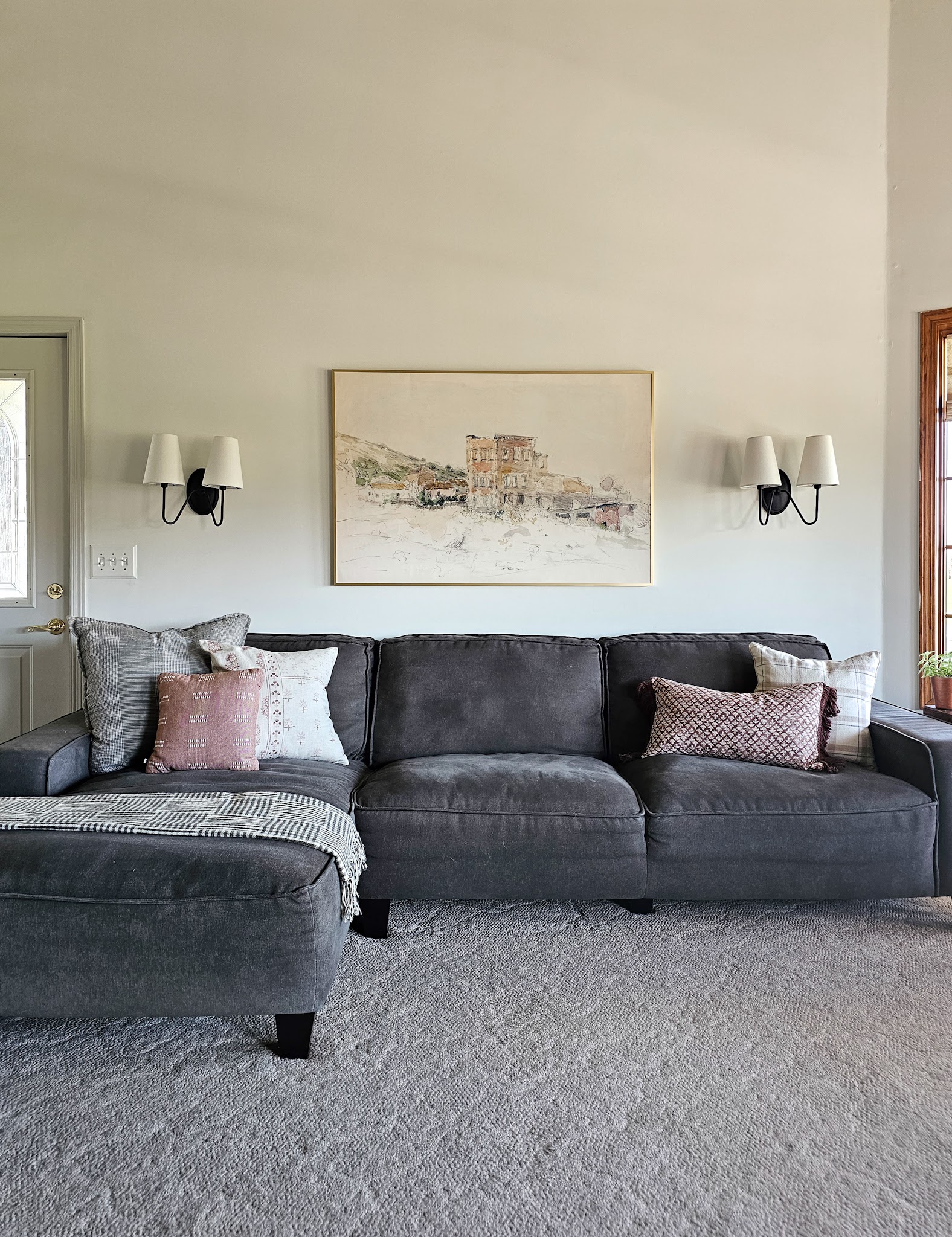
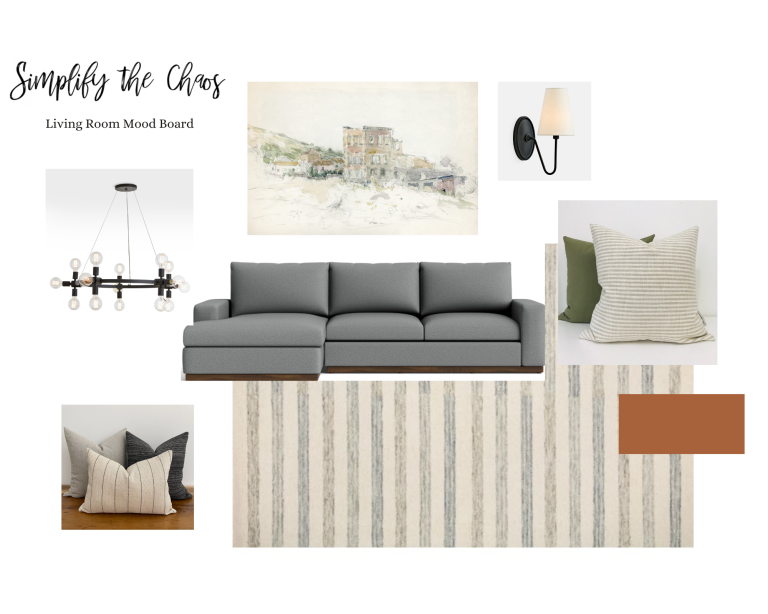
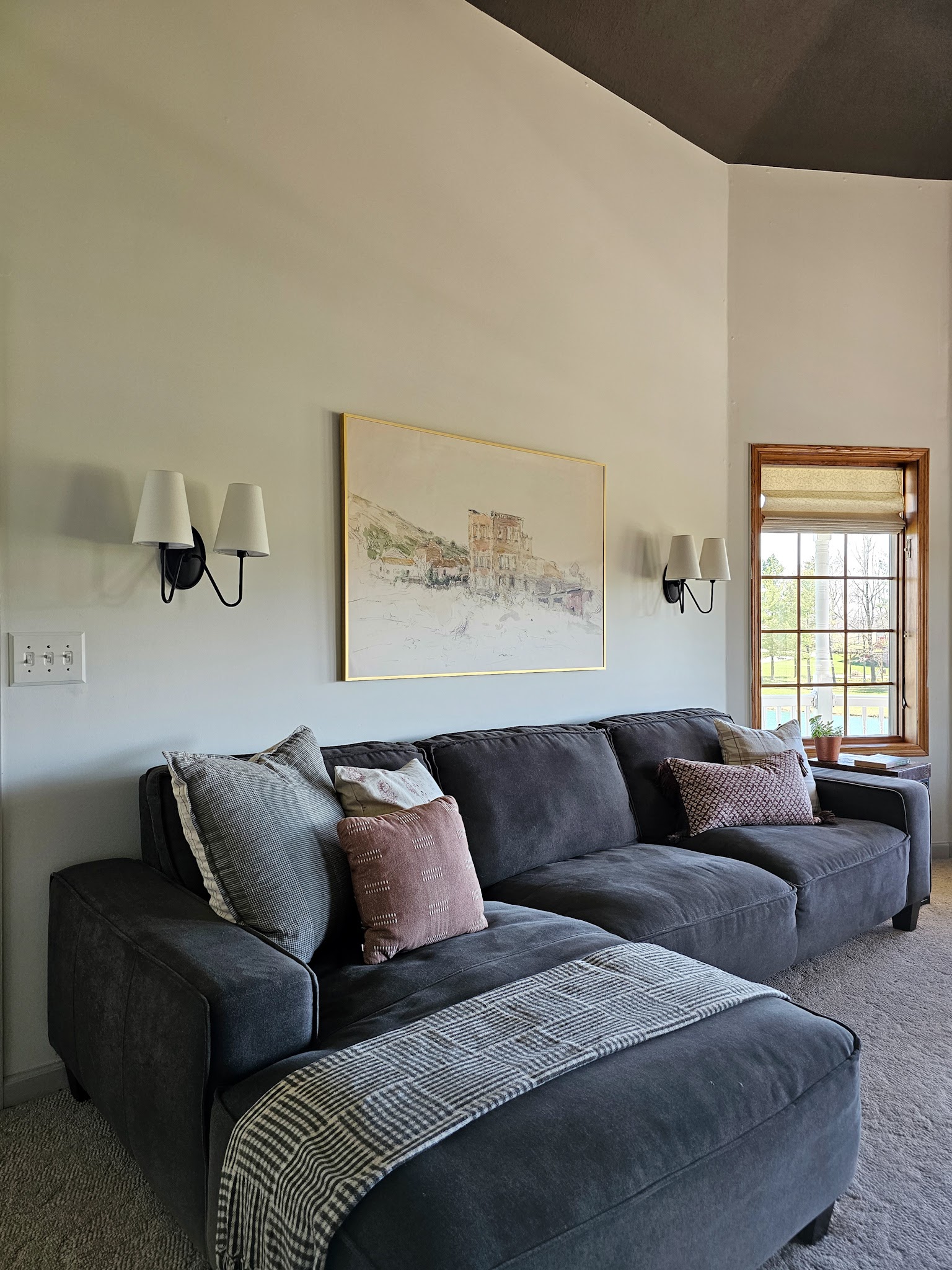
The living room is the slowest renovation we’ve tackled so far. I shared the mood board back in October and since then, I’ve painted the walls and ceiling, swapped out the ceiling light fixture, and hired an electrician to hardwire two sconces. We also purchased one new chair for the bay window area. That’s it! Basically, I’ve been taking this Phase One renovation in, well, phases, and every so often I come back to do a little bit more. This week, I finally finished off this wall:

Before-ish

Midway

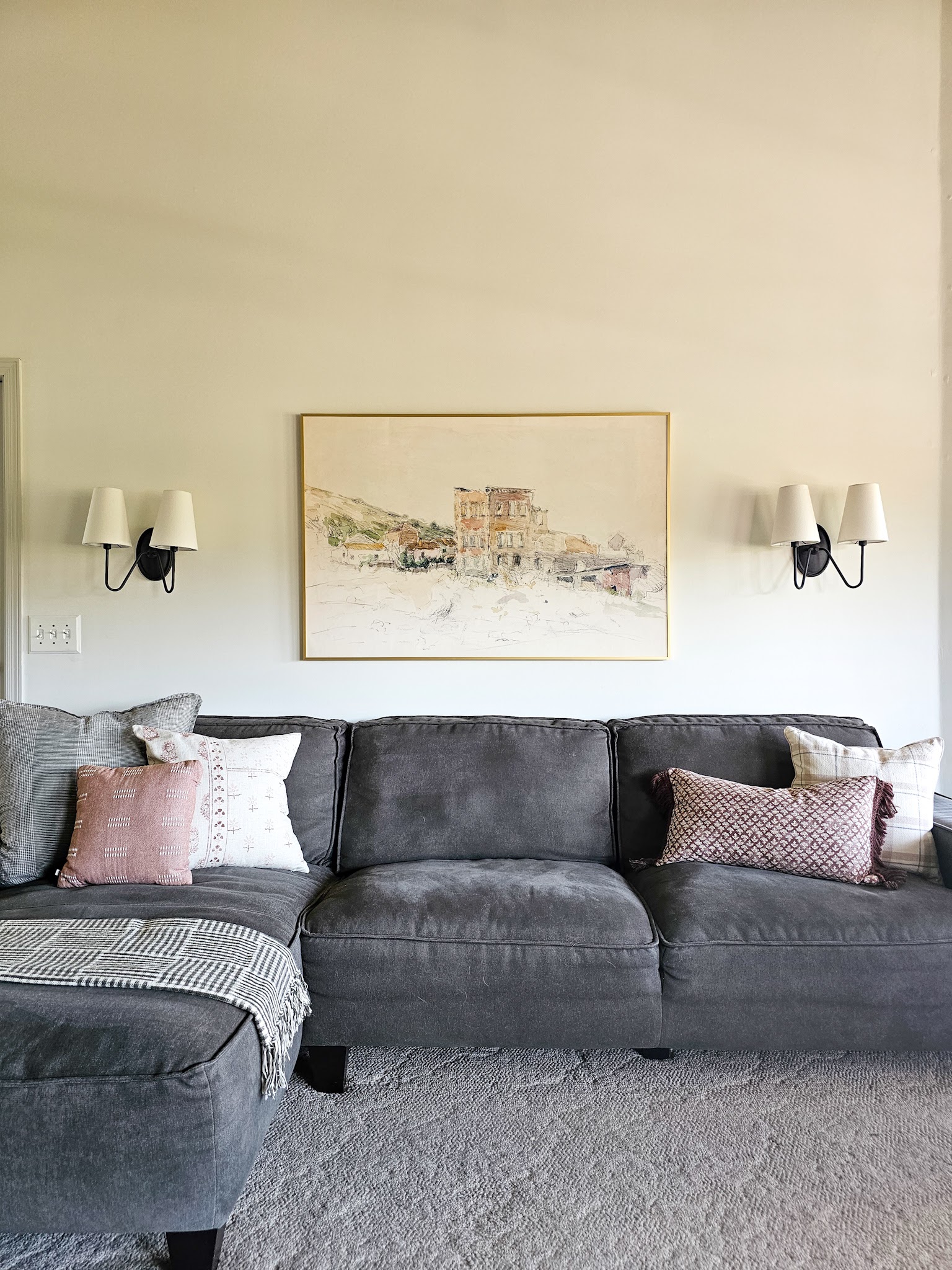
After

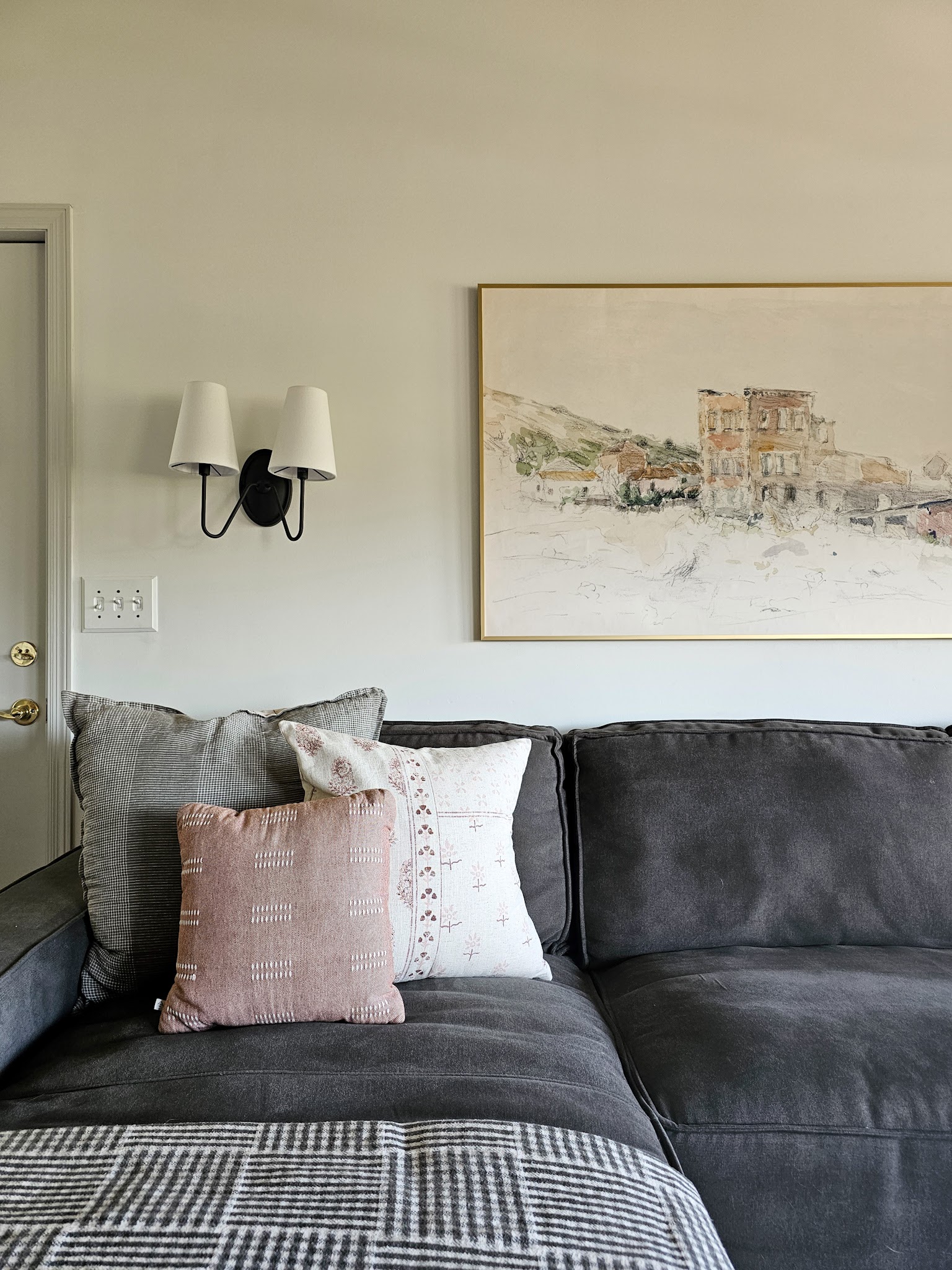
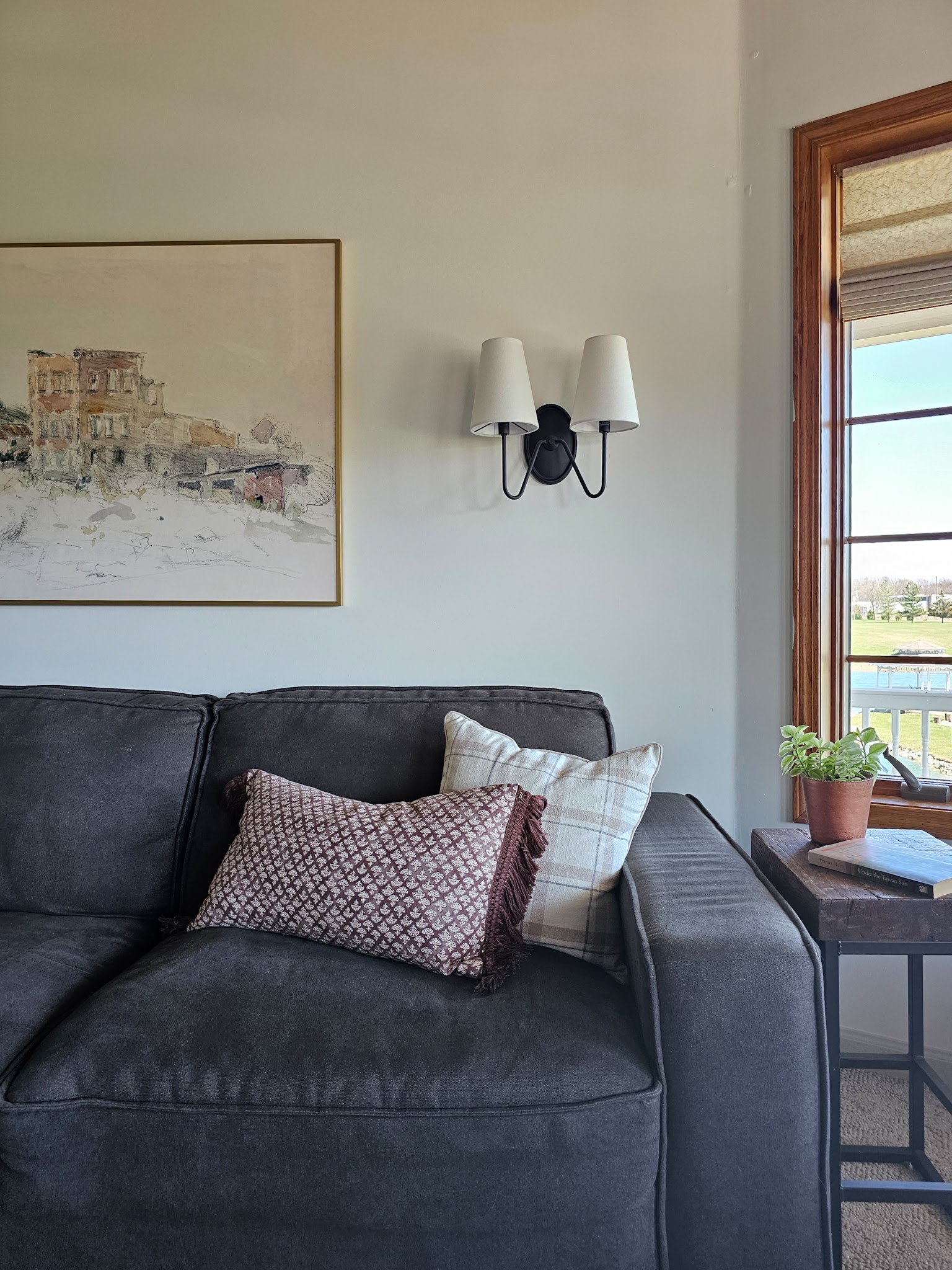
Let’s start with the artwork, as that was a driving force in all the other decisions with this view. From the start of planning this room, I had this print from Juniper Print Shop in mind. I like that it has interest, but it’s not overwhelming. The wall is huge and I had no chance of filling it; with a bold ceiling already I wanted to just have the art be a bridge between the couch and ceiling. It’s named Italian Hills and reminds me of Justin and my trip to Italy 7 years ago. I was drawn to the soft, muted colors used – it’s the same color palette that’s reflected throughout the rooms in the rest of the first floor so it felt like a great way to tie everything together.

I purchased the print as a digital download. Their website says their digital files are formatted to print up to 24×36 inches but I was able to have it printed locally at a larger size and I’m happy with the end result. (They do offer oversized prints too but I wanted a different size than they offer – more on that in a minute).

With the print in mind, I went a little bit crazy in Target and bought 13 different pillows to try out on the couch. I wanted to play off the colors in the artwork and chose patterned pillows with shades of green, taupe, and mauve. My vision was to have a mix of colors and patterns for a cozy, collected feel and I tried out numerous combinations before settling on these five.

Of the 13 pillows I bought, I’m only keeping 3. The large green pillow and small square pillow were actually two I already had – a reminder to always shop your own home first! A few new pillows gave a fresh feel to the ones I already have and I love how they all look together.

Because I was bringing in interest with the artwork and a mix of colored and patterned pillows, I wanted to keep the frame for the artwork pretty simple and streamlined. This gold frame from Frame It Easy was perfect for its understated elegance!

In the interest of full transparency, I received this frame from Frame It Easy in exchange for sharing on Instagram and providing them with photos for marketing. A blog post was not part of the contract, but I’m choosing to share about the frame and company here because I’m genuinely happy with the product and like how it looks in my living room.

Frame It Easy can create frames in whatever size you want – even if it’s super unconventional, like 14 5/8″ x 31 1/4″. I mentioned before that I wasn’t able to use the oversized prints Juniper Print Shop offers and that’s because none of their offered sizes fit the wall space in between the sconces like I wanted. I used painters tape to measure out different proportions and settled on 51″ x 34″ as my desired size. Frame It Easy asks you to put in the dimensions of your artwork and then creates a custom frame to fit. You can also upload your photo or artwork and have them print it, but due to the size of mine (and the file size given by Juniper) I had it printed locally.

Frame It Easy provided me with a link to share – if you’re interested in ordering, you can access their website through this link and you will automatically get 10% off your order, no additional code required! (I do not make a commission off of sales).

I originally used the acrylic cover that came with the frame, but because of the large bay window area in the room, there was SO much glare no matter what angle you were looking from. It really distracted from the artwork and I knew it would always bother me, so I removed the cover and am much happier with it now. I know I run the risk of my kids getting their fingerprints on the print but it felt like a risk worth taking to get to actually see all the details in the art without the glare.

I’m super happy with this wall in the living room and feel like it’s in a good place for now. It does make it pretty obvious though that the rest of the room still needs some work – as you can see from this view, the windows stick out like a sore thumb. Painting them is next on my list for this room!

Sources:

Wall Color: SW Alabaster

Ceiling Color: SW Urbane Bronze

Trim Color: SW Agreeable Gray

Pillows: patchwork, lumbar, plaid

Italian Hills Print

Frame It Easy Specs:

Art Size: 51″ x 34″

Outside Frame Size: 51 3/16″ x 34 3/16″

Style: Ashford in Satin Gold

Cover: Clear Acrylic (I removed)

Backing: Acid Free Foamcore

Order Here for 10% off your order (offer good through May 24, 2023)

Easy, Functional Lego Storage

About six weeks or so ago, Justin and I completed a DIY Lego table for our kids. It has been a big hit with our children, particularly LJ, and has already gotten a ton of use. I knew when we completed the table that I needed to also address the storage for all the excess Legos and the past six weeks have made that even more evident. I finally took some time yesterday afternoon to organize our stash and I can’t believe the huge difference it made!

We had been working with a hodgepodge of storage bins: bright blue divided bins from when Justin was a kid, random clear bins from around our house, and white narrow bins I originally bought for the Legos. I totally blanked on taking a before picture, but I took a video of my organizing process and grabbed this screenshot from the beginning to give you an idea of the chaotic storage situation.

It took me a long time to find bins that would work for my purposes. I wanted lidded, stackable bins that were somewhat cute since they will always be out and visible. Size-wise, I didn’t want them to be too tall, since we don’t want a deep pile of Legos inside, but they needed to be tall enough to fit some type of divider. I also did NOT want them to be clear, which ended up being the hardest requirement! A lot of bins fit all my other parameters but were clear; I specifically did not want clear because when the Legos are put away, I want them to be somewhat discreet. The whole purpose of the Lego table was to corral Lego creations and keep tiny pieces up off the floor, away from little ones. By having opaque bins, I figured they’d be less enticing for curious little hands. Whenever babies or toddlers are in the basement, there is always adult supervision but I figured any extra help to keep them uninterested in the Lego space is going to be beneficial.

I thought I had hit the jackpot with these cute white bins, but I didn’t factor in the inset lids and bottoms – these plastic dividers fit inside but were slightly too tall to allow the bins to stack with the inset. I kept searching and finally landed on these Ikea bins – they were a little taller than I would have liked but they fit all other requirements so I decided to go for it. I chose the Kuggis in 10.25″ x 13.75″ x 6″ size.

I wanted adjustable dividers to customize sections based on the amount of Legos in that category. These plastic dividers were perfect! The length fit perfectly inside the Ikea bin; to adjust the size to fit the width of the bin, I just bent the divider back and forth at whatever length I needed. Sometimes it broke just with bending, other times the bend helped weaken the plastic and I could cut it with a scissors easily. I also used the scissors to trim off any sharp edge of plastic to keep edges smooth and safe for the kids.

I have no grand illusions of this staying perfectly organized, so I didn’t stress out too much over categories. I just tried to divide things in a general way that would make pieces easier to find. LJ’s exact words were “Mom, this looks so much better!”

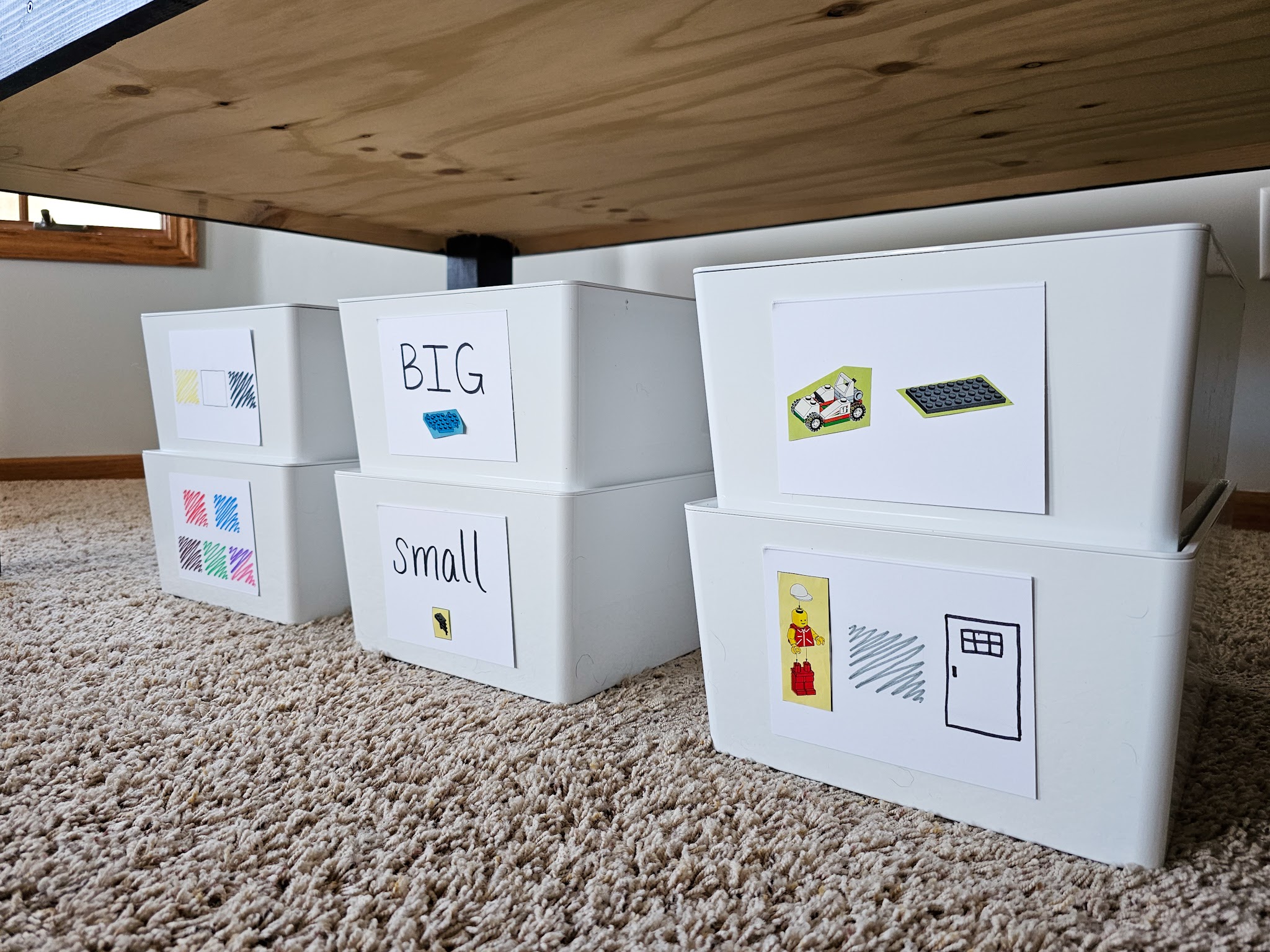
My kids can’t read yet so I kept bin labels simple. I used cardstock, markers, and a few cutouts from an old Lego instruction book to remind them what was in each bin.

LJ could tell right away what each picture meant, so mission accomplished! Justin and I did decide on two catch-all bins of all the “weird” pieces that don’t really fit any category and we divided them into a big piece bin and a small piece bin; the former teacher in me loves the chance for them to start to recognize those simple words as they play!

I’m super happy with the result of this quick organization. It was such an easy way to *ahem* . . . simplify the chaos. šŸ˜‰ And honestly, even if the divided categories don’t end up lasting and all the Legos end up in piles in the bins, I’m satisfied knowing the storage bins will continue to hold up and keep things discreetly contained for years to come.

How We Made our DIY Lego Table

I just love a good DIY date. Last week, I shared plans and inspiration for making a Lego table for our kids and over the weekend Justin and I worked together to create our own. It was so fun to work on this together and I love how it turned out!

We decided to keep things simple with a basic table that could corral tons of Legos and provide a big workspace for creations. I also wanted it to have a top that would not only act as a lid for keeping all the Legos stored away but would create a regular table for other activities when needed. Today I’m sharing exactly what we did, including a few mistakes we made along the way, in case you’re interested in making one too.

Materials

-large piece of pine plywood for the table base (we got pre-sanded)

-large piece of oak plywood for the table top (we got pre-sanded)

-pine 1×6 (we needed two)

-oak board (we ripped down a scrap piece, similar in size to a 1×2)

-wood glue

-1 3/4″ wood screws

-wood stain (we used this one)

-black stain (we used this one)

-polyurethane

-foam brushes, latex gloves, and fabric rags for stain application

-220-grit sandpaper

-tools used: tape measure, clamps, miter saw, drill, impact driver, circular saw, nail gun, orbital sander, table saw (only used to rip down our repurposed wood)

The first thing we did was determine the size of the table. I wanted the table to comfortably fit Lego baseplates so we chose dimensions based on how many baseplates we wanted to be in use. (Note: I made two mistakes here. I measured the baseplates quickly and said “oh, they’re 10x10s!” and went off that, when they are in fact 10 1/32″. I was close, but learned the hard way that being a tiny bit off can cause issues. Also, I did not realize that when you actually click Legos in across baseplates, it separates the plates a teeny bit. Nothing too significant, but again, enough to make a difference in measurement. Make sure to take this into account when determining size! More on these mistakes later.)

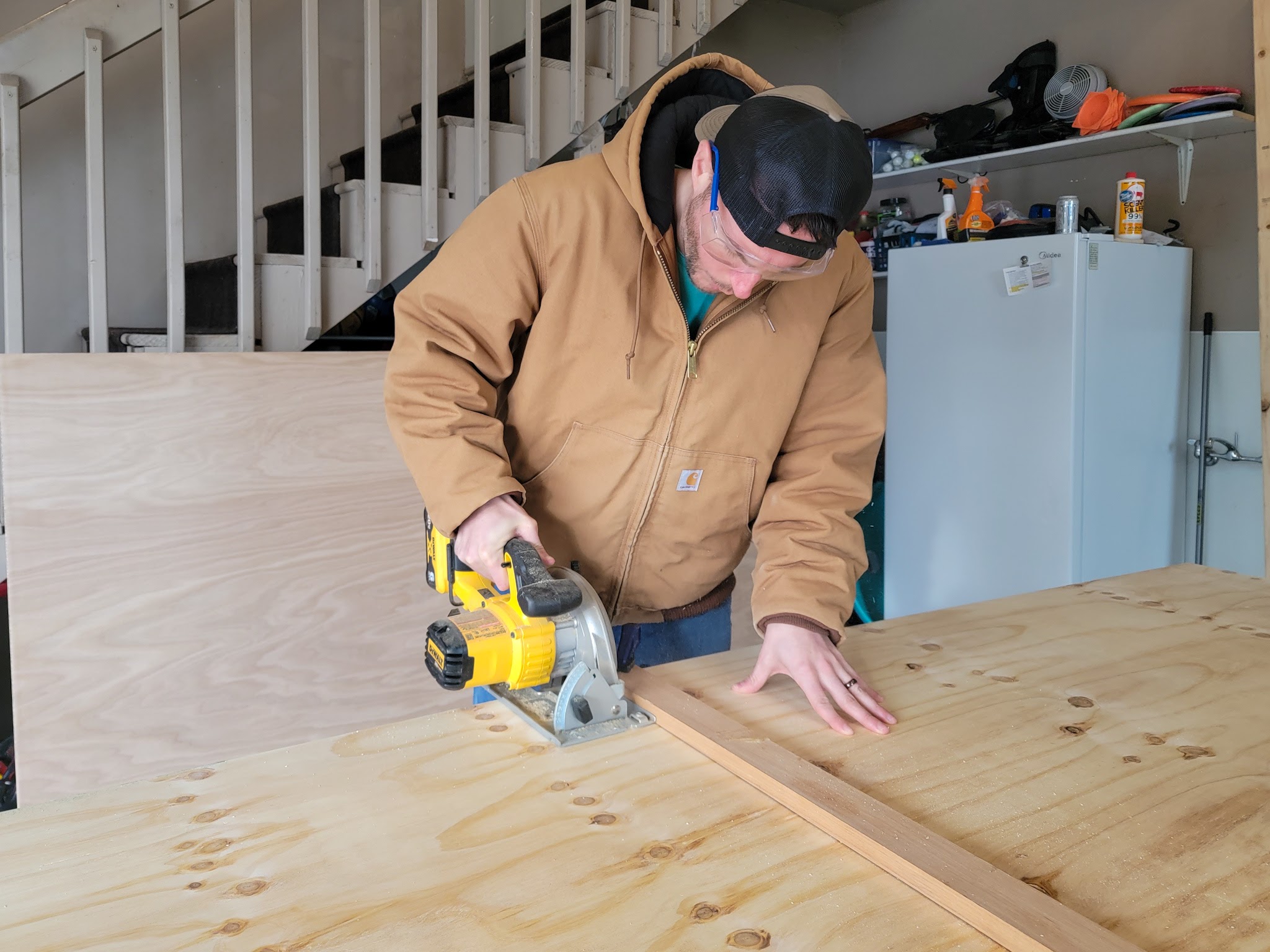
We measured and marked the desired length and width onto the pine plywood. We accounted for 1/8″ wiggle room and Justin used clamps and a long piece of scrap pine to serve as a guide to keep the cut straight. He used his circular saw to cut both sides; the saw will cause a bit of splinting on whatever side is facing up, so have the nicer side facing down! I lightly sanded the edges with a piece of 220-grit sandpaper to remove the splints.

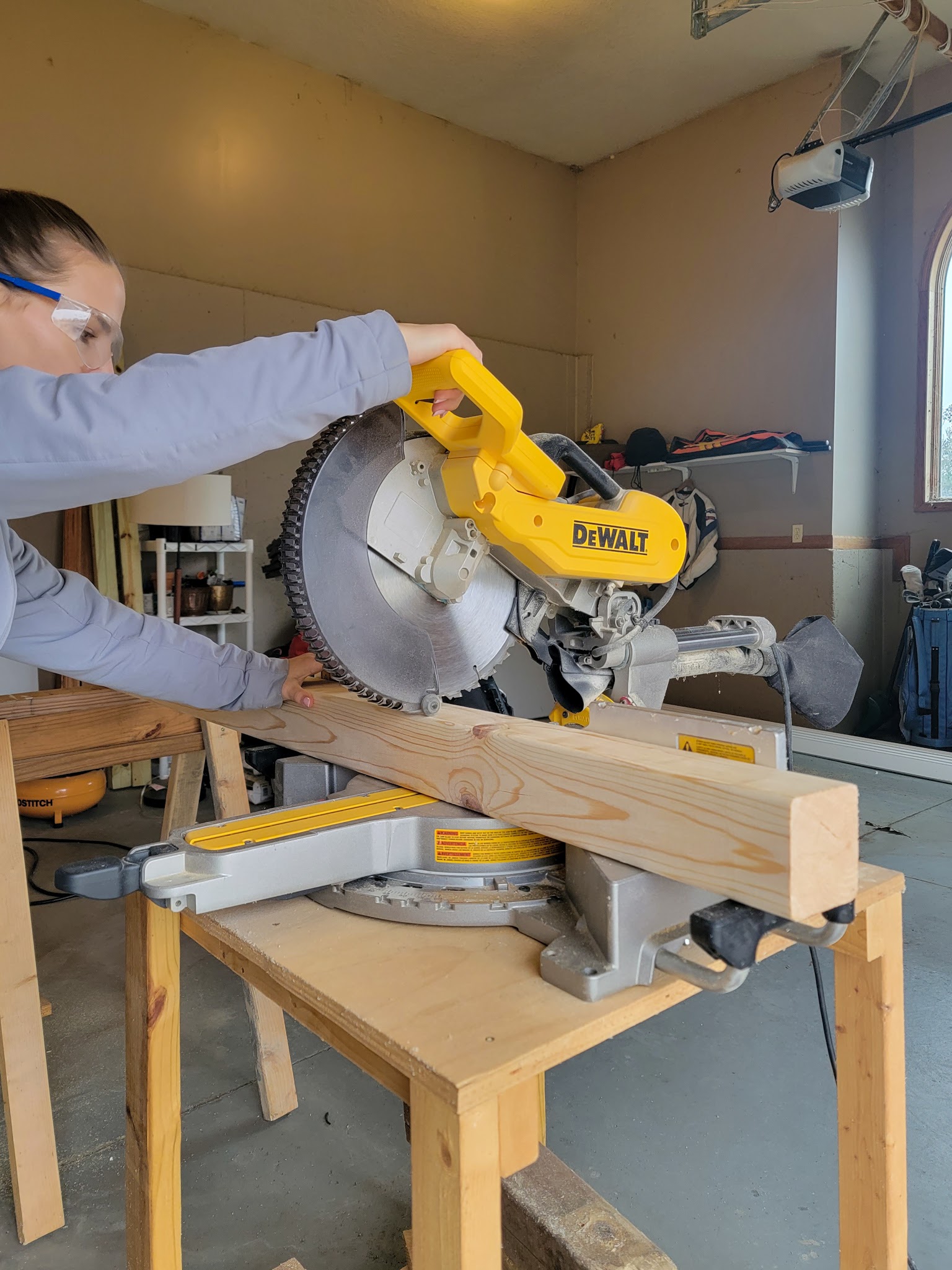
We determined the height we wanted based on a combination of factors – we wanted it a little higher than our train table but a little lower than our play kitchen. We determined 19 1/4″ for the legs (so with the 3/4″ plywood on top, we’d be at a 20″ table height) and I used the miter saw to cut them all to size.

We installed the legs using two 1 3/4″ inch wood screws from the plywood down into each leg. We highly recommend drilling pilot holes first!

Also, make sure you’re thinking about how you’re going to be installing the table sides and place the screws going down away from where you’re going to need to screw in from the side.

To create sides, we used pine 1x6s. I started with the short ends first and measured the precise lengths of the plywood (measure each side individually in case they’re not perfectly the same). I cut the 1×6 down to size using the miter saw. We played around a bit with the placement to determine how high of a “fence” we wanted around the table. We wanted something tall enough to corral all Legos and allow for creations to remain in place once the lid was on, but something short enough for little arms to reach over and access the middle of the table easily.

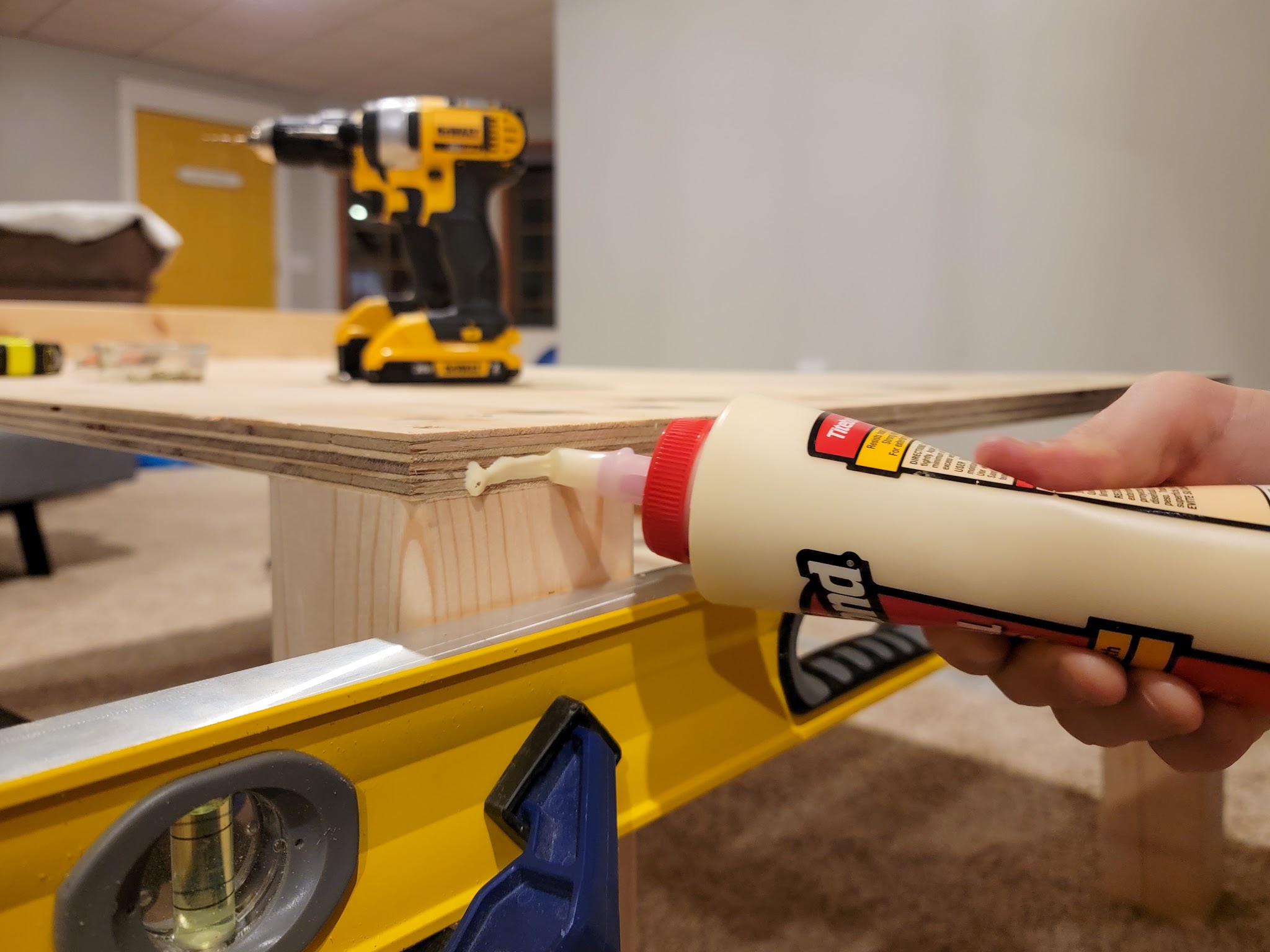
We settled on a placement that created a 3 1/4″ fence around the table. Justin came up with the idea to clamp a level to use as a guide to rest the 1×6 on to make sure the wood was installed straight (we did not use the level itself to determine “levelness” since the floor might not be level, but instead measured from the plywood down on both sides to make sure placement was consistent).

We ran a bead of wood glue across the edge of the plywood and used a wood screw on each end to drill into the legs (this is where it was important before to make sure to space out the screws going down into the legs!) We also ran a wood screw into the plywood in between the two legs for extra security.

The hardest side to install was the second short side – it needed to be exactly the same placement on the table as the opposite side but wasn’t being installed flush against an existing side, so we had to measure very carefully to ensure we placed it at the correct height. Double and triple check this before installing!

We followed the same process for the long sides, making sure to line up placement with the short sides. On these sides, we used four wood screws per side – one in each leg and two spaced out in between. We also used a nail gun to attach the long side edges into the short side ends.

At this point, the base was complete! I filled the nail holes with wood putty and gave all surfaces a light sand with 220-grit sandpaper before staining. (Note: We specifically chose pre-sanded wood to give ourselves a break on sanding, but I still recommend going over everything at least once to ensure no splinters!) I chose this black stain color and gave the table two coats of coverage. I chose to leave the inside base of the table natural since it would be covered by baseplates.

For the top, we measured the dimensions of the installed table sides and cut down the oak plywood to size using the circular saw and guide again, adding on a half each each way for some wiggle room. I went ahead and stained the bottom side of the table in this stain color.

For the lip of the table, we repurposed an oak board we had removed from our guest room during that renovation. Justin planed it down to remove the old stain and ripped it into strips of 2″ width. I used a miter saw to cut the sides to length, once again starting on the short sides, and I stained the “inner” side before installing.

We installed the tabletop sides similarly to how we installed the table base sides: we ran a bead of wood glue along the plywood edge and then used a nail gun to add a few nails along the side for extra stability. We did the short sides first, long sides second. We let everything dry, I filled in the nail holes with wood filler, and then Justin used his orbital sander with 220-grit paper to smooth all the sides and edges.

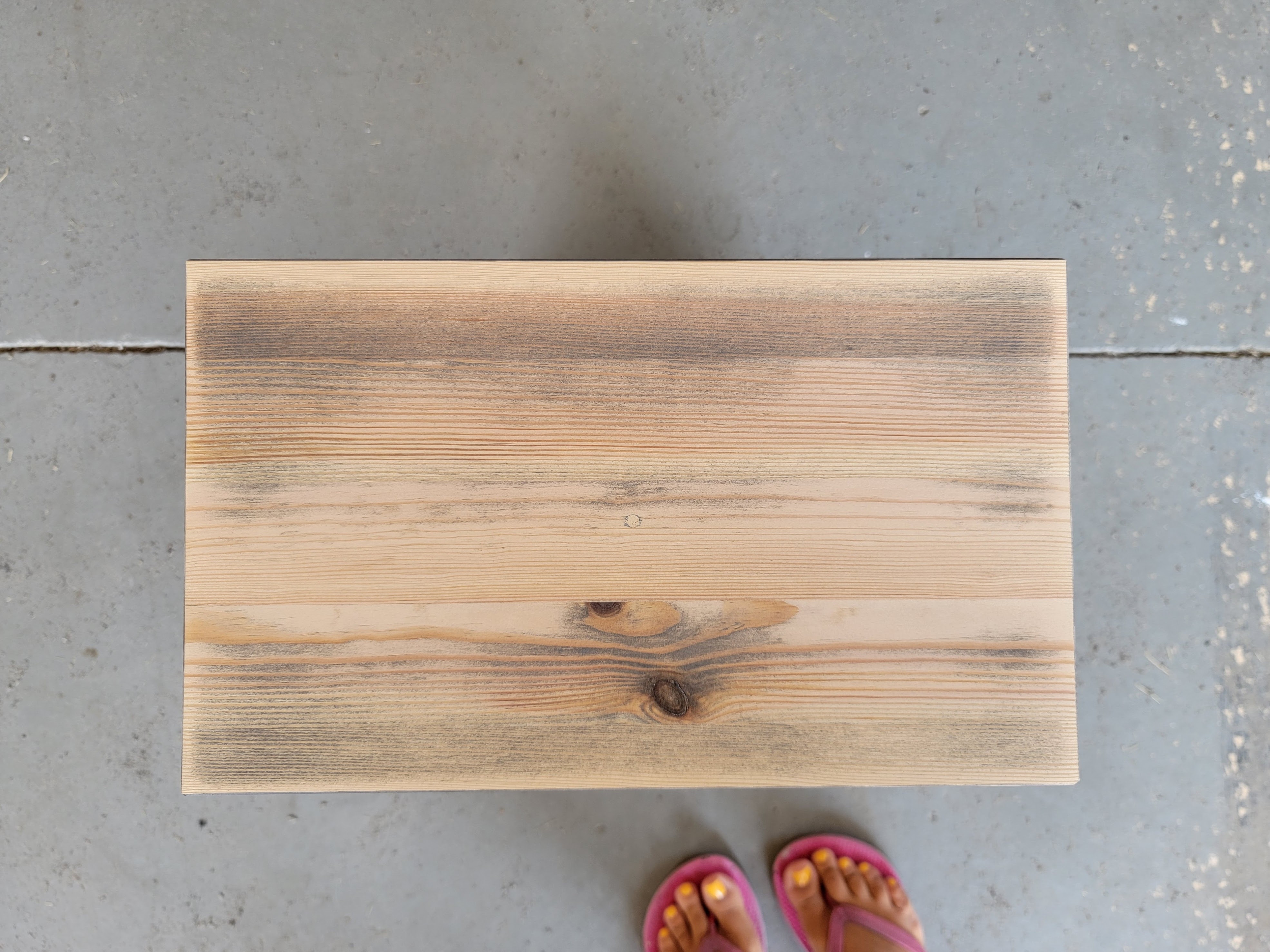
I gave the top a layer of the same stain and let everything dry, then added a coat of polyurethane to the tabletop.

This *should* have been it, but remember how I warned you to make sure your Lego baseplate measurements are exact? Well…mine weren’t and we ran into this issue when installing them. We had left enough wiggle room for the baseplates to fit across the shorter side, but for the longer side, the 1/32″ addition compounded over 6 baseplates meant that despite the built in wiggle room, the last piece didn’t fit!

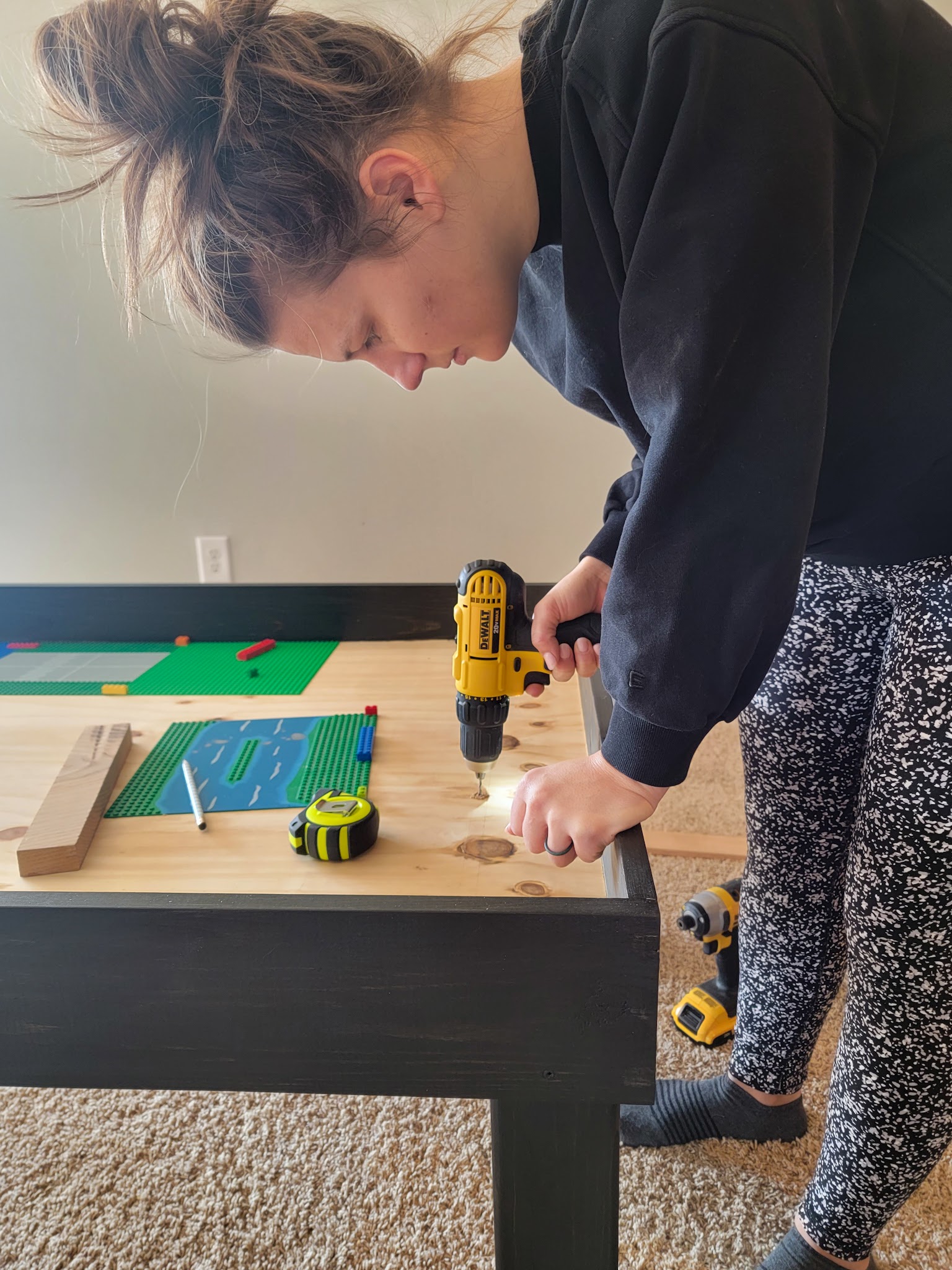
Our solution was to take a scrap piece of pine (it was an odd size scrap piece – I think like 1/2″ x 2 3/4″ dimensions) and create a fence inside the table. We cut the board to fit side to side in the table, traced both sides of the board, and drilled pilot holes in the exact center between those lines.

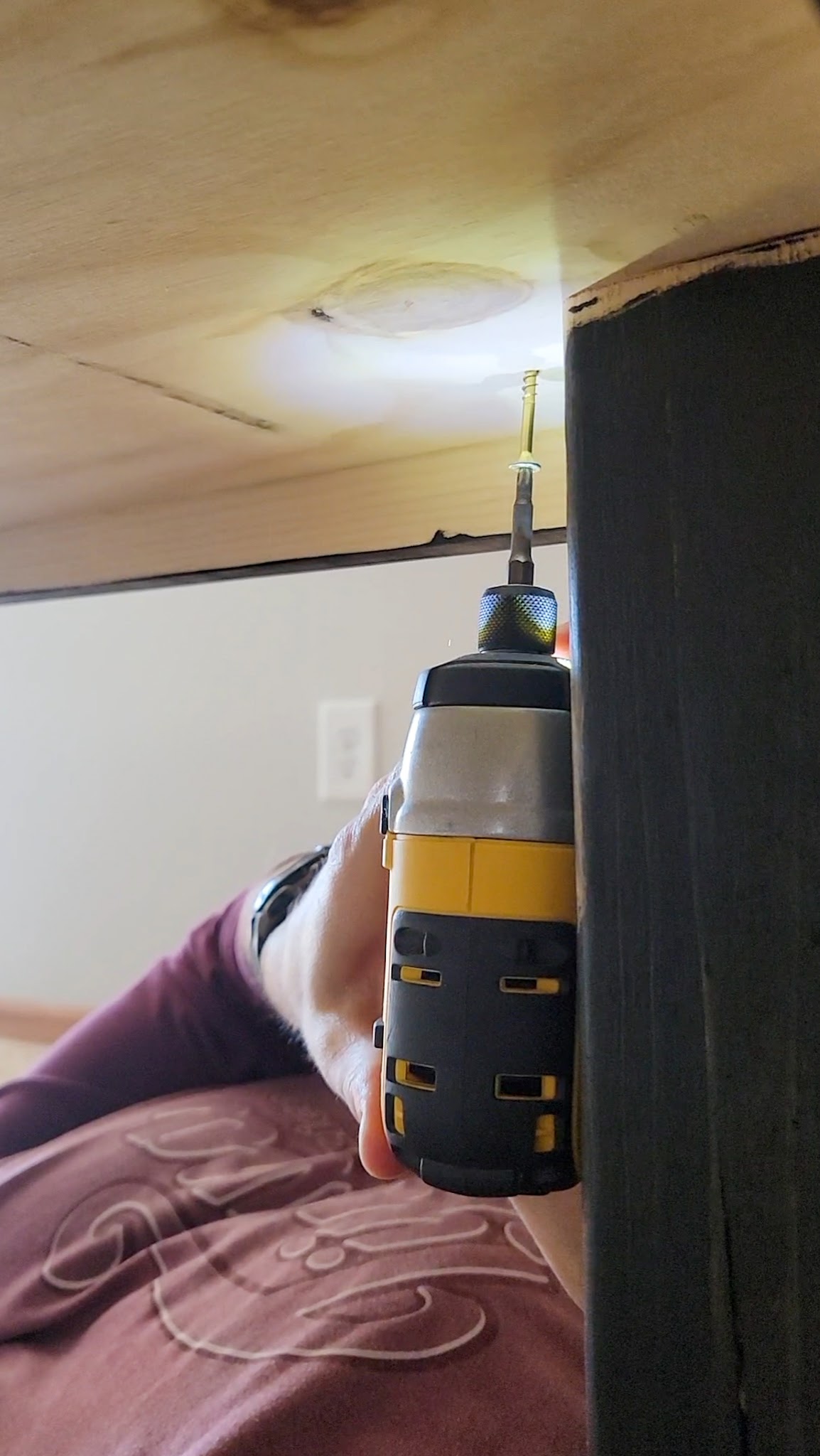
Then we held the board back in place, and used wood screws to drill up into the pilot holes from the bottom up.

This created the perfect size surface for baseplates to fit and gave us a little area for loose Legos to be kept in. It wasn’t what we planned but it was a good solution for our dilemma! We chose not to attach the baseplates directly to the tabletop so they can be swapped out for whatever the kids are making.

The Lego table was complete and let me tell you, it has been a HIT with both of my big kids!

I love the option of having the tabletop on to cover all the Legos – I’m imagining this will get used many times over the years for crafts, activities, birthday parties, and overflow seating when we entertain. We already put it to use during our Super Bowl party on Sunday and it worked perfectly as a table for kids to eat at!

I also like that we can cover up the Legos if we have younger children over for a playdate. That being said, most of the time, the table will be uncovered. When that happens, the kids can actually use the lid upside down for additional Lego creation space!

Seeing this table in use at the Super Bowl party got me to thinking . . . we might want to make some small benches to fit under the table, right? They would be perfect for sitting around the table to eat, craft, or, of course, play with Legos! I’m guilty of “if you give a mouse a cookie…” syndrome and well, that just might be another project to add to the list. šŸ™‚

First Project of 2022: Leveling Up the Guest Room!

Almost exactly two years ago, we finished up the first renovation in our home: the guest room. Hosting friends and family is very important to us so we wanted to prioritize having a nice space for them to stay. We certainly did not anticipate that we were about to enter a global pandemic, but even though the room hasn’t gotten quite as much use over the past two years as we expected, we are still glad we decided to focus time and energy on renovating the space.

20191028_125657-1

I don’t really subscribe to the thought that a room is ever truly “finished” – our home is ever evolving and I even when a renovation is complete, I still enjoy making tweaks and leveling up a space over the years. I shared in the fall that I was wanting to do a little update to the plain white walls in the guest room by creating the look of wallpaper with a stencil; you can read all about the inspiration here and the progress here. In this post I debated between keeping it an accent wall or continuing around the whole room and for my first project of 2022 I’ve officially decided to continue it around the whole room.

I won’t lie, because I’m using so many different colors in the pattern, this is going to be a time consuming process. It’ll certainly take much longer than the laundry room stencil, which was one color and could be rolled on with a foam roller. With my work-from-home job plus my two small children keeping me pretty busy right now, I’m going to just be carving out time here and there to work on this when I can. I’m not going to put a timeline on it either – we don’t have any scheduled guests coming yet in 2022 so there’s no pressure at this point. I’m excited to see the space slowly transform!

There are a few other things I want to tweak and update in this space. For one, the boob light has got to go! This is something I didn’t change out in our original renovation and it’s definitely time for something new (one of my 2021 goals was to replace all the boob lights in the house and this is the last one remaining!) I’m also going to update the bedding (I regret choosing a comforter set with lots of decorative pillows – too impractical for guests!) and possibly add a bench at the foot of the bed. One of my 2022 goals is to update the flooring in this house, which includes the carpet here, although that likely won’t happen until later in the year.

I’ll be sharing some of the real-time progress on this project on Instagram, so be sure to follow along there if you want updates in the moment!

ORC Week Six: Laundry Room Shelving, Lighting, and More!

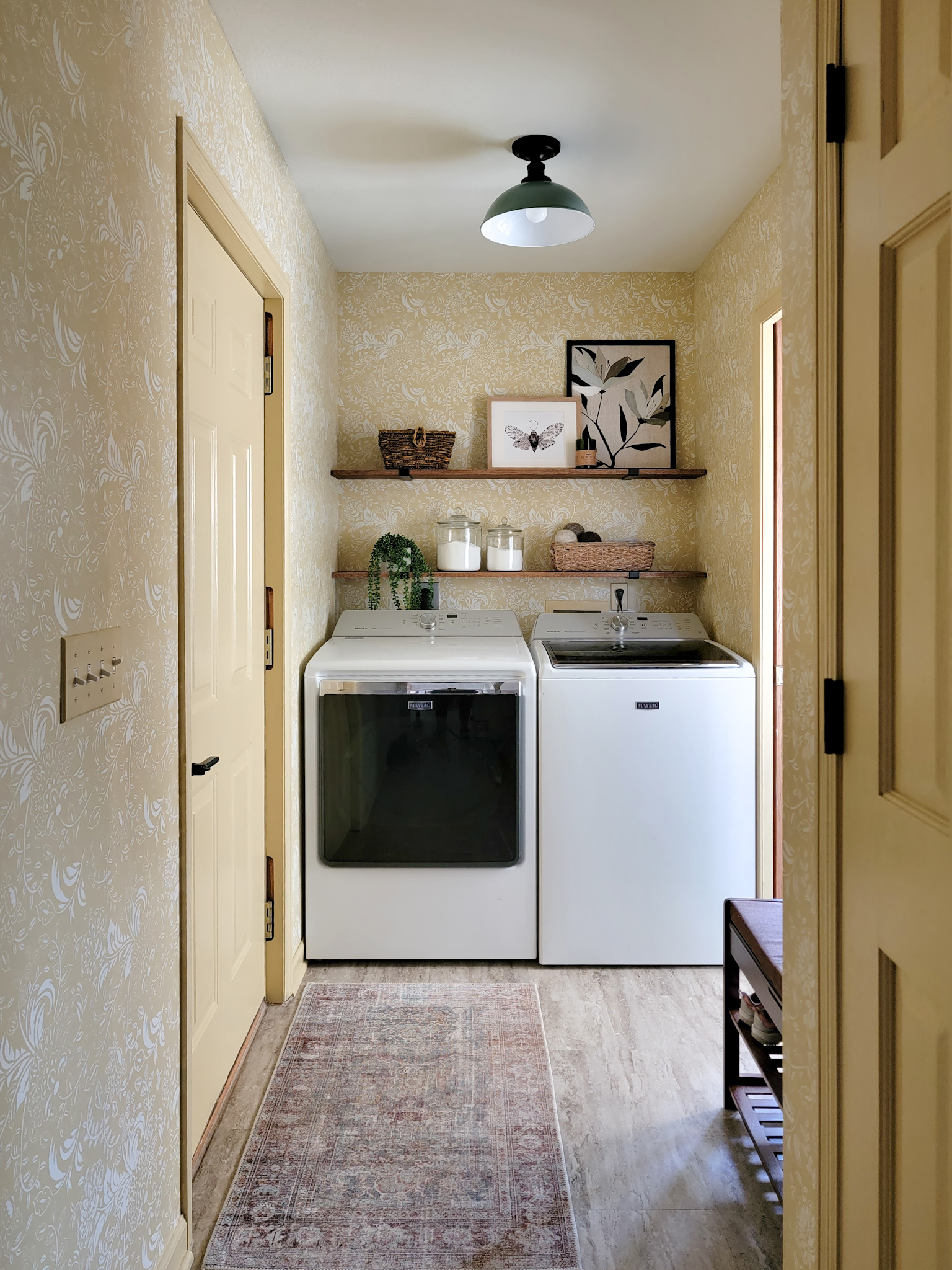
This week was a big week for progress in the laundry room! Shelving was built, lighting was installed, doors were finished – the room is really coming together and I am loving it.

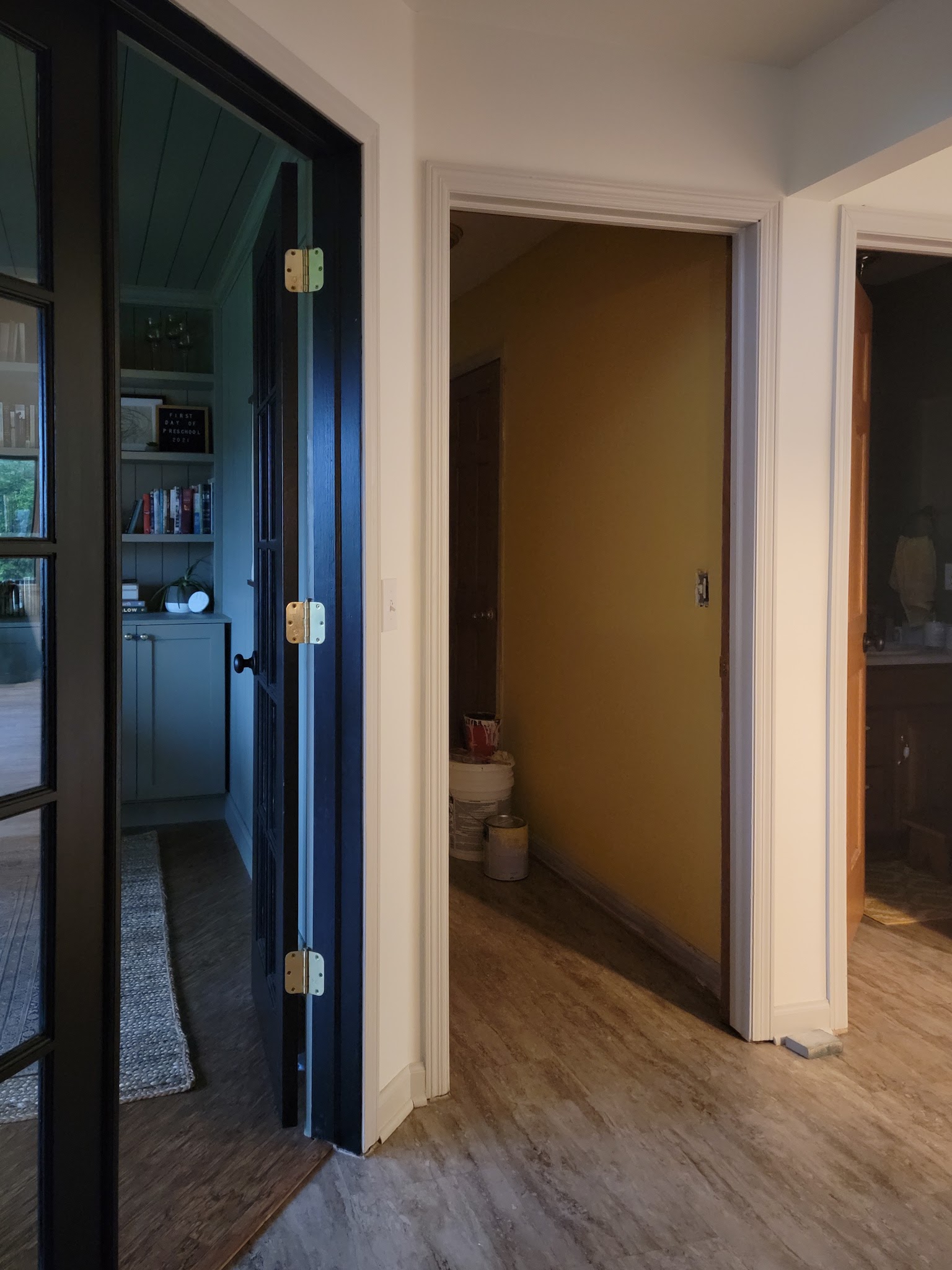
And because it’s always fun to look back on how far we’ve come, here’s where that same view was six weeks ago:

Originally, I envisioned creating floating shelves from wall to wall, but as it came time to work on the shelves, I decided to pivot a bit.

Floating shelves are pretty time-consuming to make from scratch and I haven’t had as much time as I had hoped to work on this room lately. Plus, the more I thought about it, I realized that since this is just a phase one renovation (we still plan to fully gut and renovate this room and the adjacent bathroom to create a bigger laundry + mudroom in a few years), shelves with brackets would be easier, quicker, and less expensive. It just made more sense to keep this project simple!

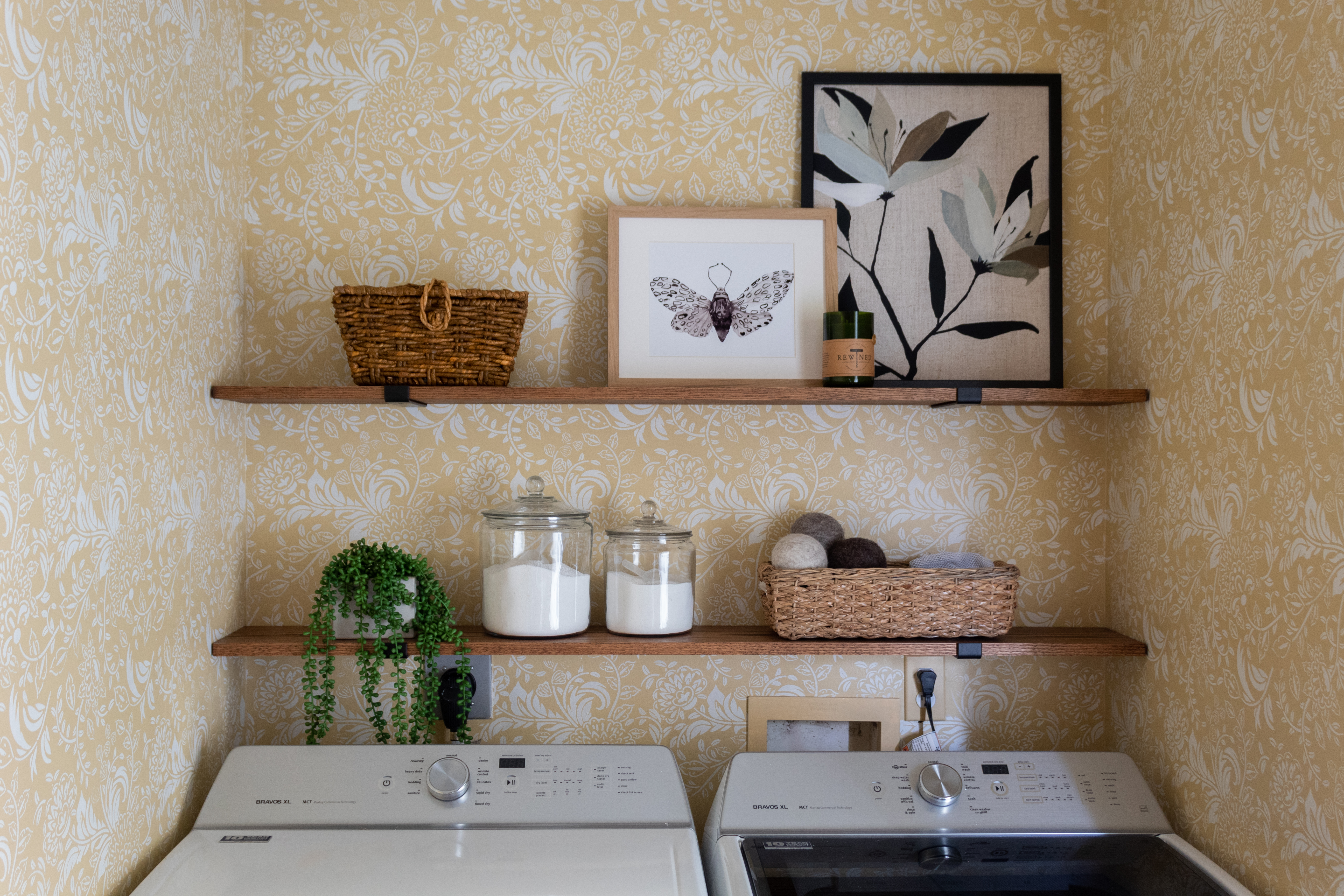
Justin had a few extra 1 x 8 oak boards leftover from a previous project and they were the perfect width to create two shelves. Using our miter saw, I cut two boards down to fit wall to wall and then gave them a light sand with our orbital sander + 120 grit sandpaper.

I wiped them down with a tack cloth and stained them with a stain we already had. Once the stain dried, I used a foam brush to apply a layer of this polyurethane and boom – shelves were ready for install!

I purchased these black brackets and Justin installed them after work using his new laser level (this thing was SO handy and I know we’ll be using it many times in the future!) The whole project took maybe 3-4 hours of active work time start to finish. Simple, easy, and inexpensive – win, win, win. I am so thankful to have functional storage that looks great!

A few other things that happened this week: I finished painting all the doors and trim and Justin installed new matte black door hardware. It’s always surprising to me how small details like door hinges and levers can pack such a big punch!

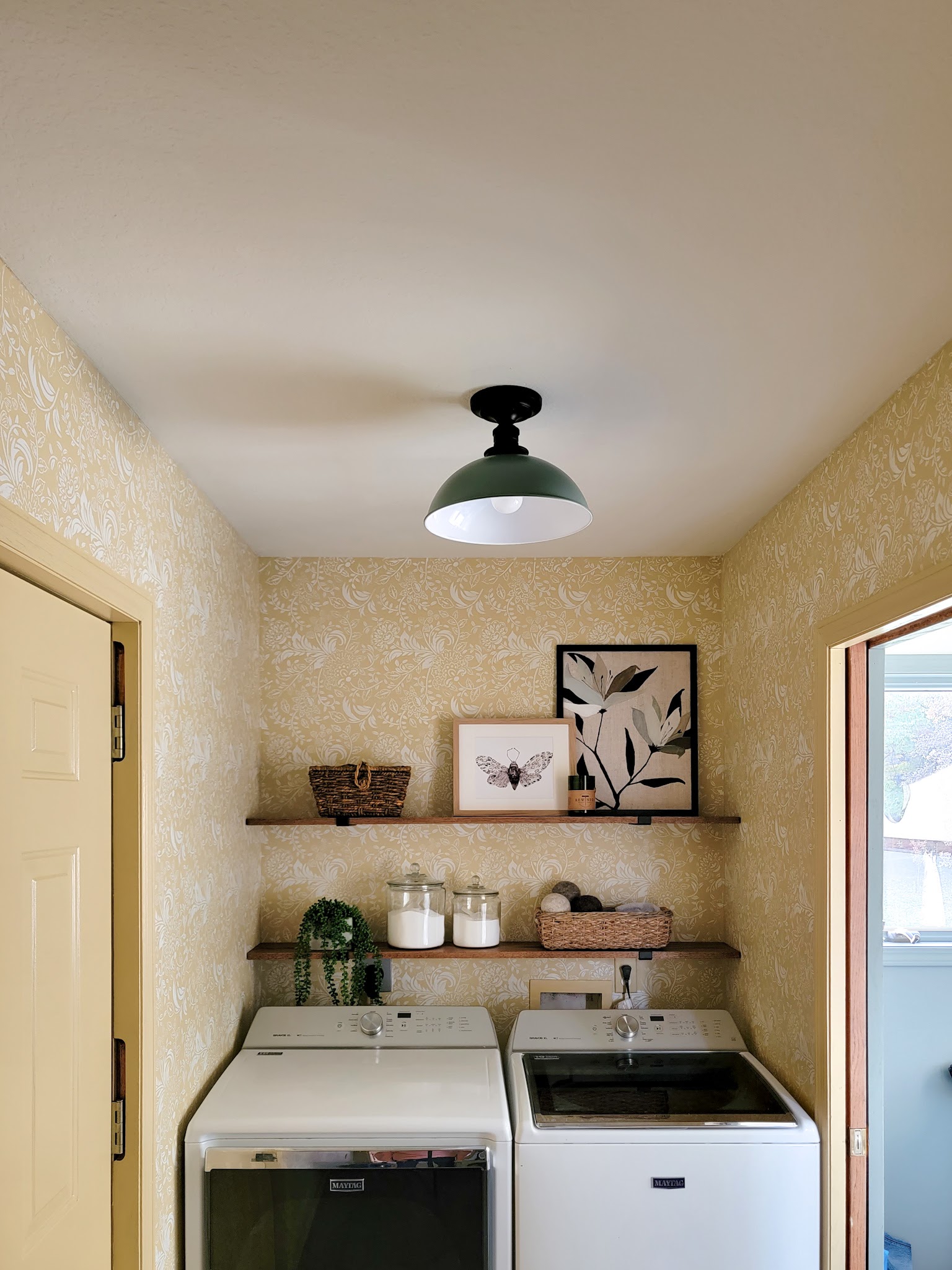
We also finally updated the two boob lights. I wanted a recessed light for the ceiling above the hallway portion but the type of junction box that had been installed prevented my first two choices from working. I settled on this low profile light and we’re happy with it – it is inconspicuous enough that it sort of just fades into the ceiling and doesn’t take visual attention away from other elements of the room.

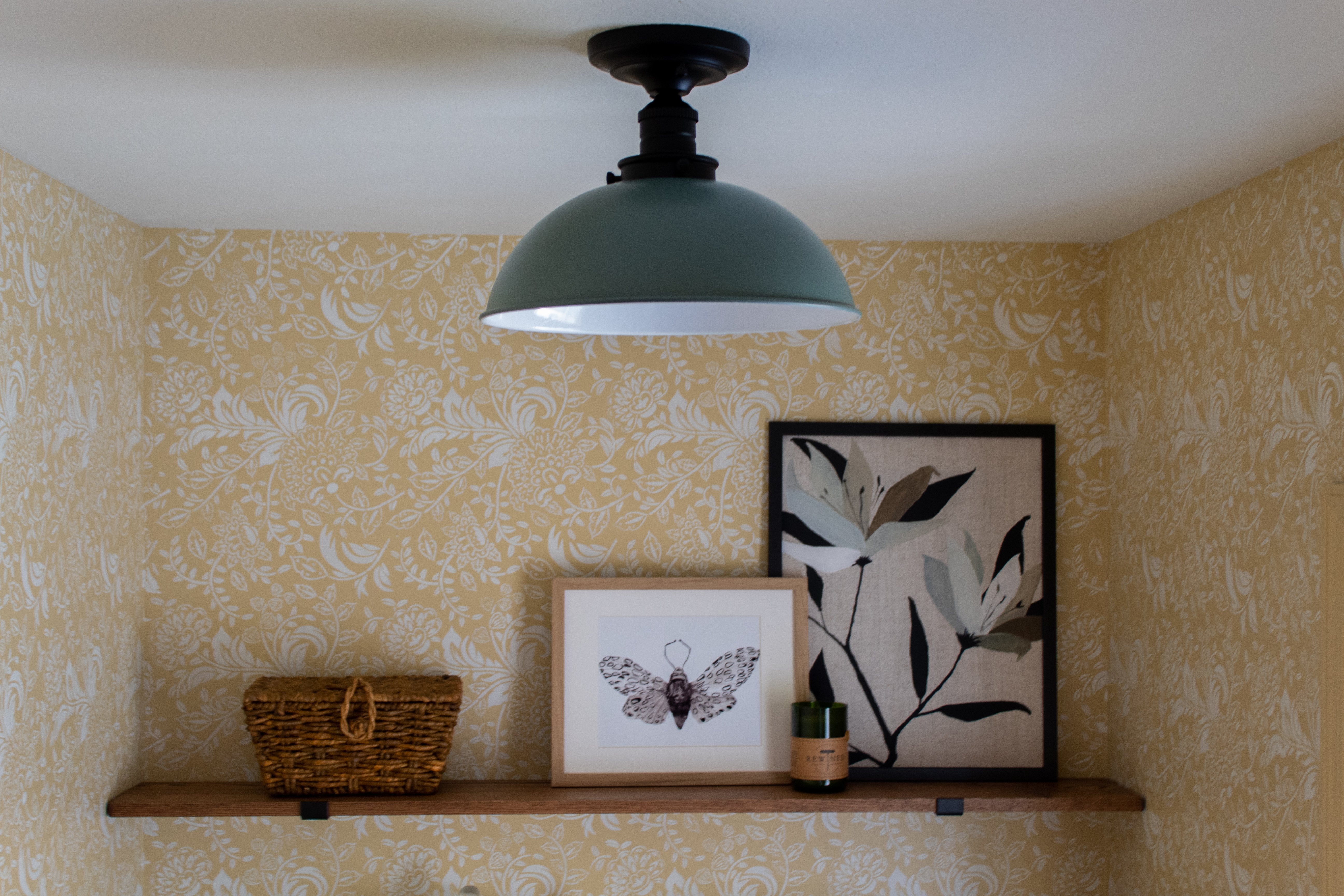
I mentioned last week that the initial light I wanted for above the washer and dryer was out of stock or backordered on several different sites, so I once again decided to pivot a bit. I really liked this light from Rejuvenation but I struggled to pick a color. It’s just so hard to know if the color you see on screen will translate to real life like you expect! At $229 . . . I wanted to be very sure I liked the light. Then yesterday evening, I was walking through Lowe’s and happened to see this light out of the corner of my eye. I was immediately inspired to do a little DIY upgrade and create the look I wanted for less.

I purchased the light and a can of this spray paint. I use painter’s tape to block off the lightbulb hole of the dome and set it down flat on a large piece of cardboard. I sprayed several light coats of the spray paint until I had even coverage and let it dry. Justin installed the mount and I screwed on the dome.

The Rejuvenation light was $229 and this one was $59. Add in tax and the cost of spray paint, and this light ended up costing me around $70. A big savings and I think it’s a pretty good dupe! This also served as a reminder that a little creativity and bravery can go a long way. Justin couldn’t believe I would spray paint a brand new light, but I knew the look I was going for and just went for it. I’m so glad I did – I’m thrilled with the light and the way it fits the space!

We’ve got two weeks left in the challenge and I’m just about finished with my to-do list. I still have some tweaking to do – for now I just shopped my house and pulled some art, a rug, and a few little decor pieces to get a feel for what works in the space. I also still need to create some hanging storage for coats above the shoe bench to finish off the little mudroom corner. The end is in sight!

Be sure to check out all the other ORC participants here!

ORC-Guest-400x218.png

Fall ORC Week 2: Big Bird is (temporarily) in the house

This past week we took a few steps forward in the laundry room and one unfortunate step back.

ORC-Guest-400x218.png

Justin spent time on Saturday morning patching all the dings, nicks, and imperfections on the walls…of which there were a lot.

I sanded all the patched areas down, wiped down the walls, and painted a layer of primer on the walls and trim.

I love the idea of doing a wallpaper in this space, but since it’s likely temporary (we plan to fully gut renovate this room and the adjacent bathroom in a couple years) I decided to stick with paint. I love yellow and while I probably wouldn’t choose it as a long term paint color for a room, I thought it’d be fun to have a cheery yellow laundry room for now.

On Tuesday morning, my kids were in preschool and I really wanted to get some painting done. I live about 20 minutes from the store and I didn’t want to drive in, get samples, drive home, paint the samples, wait for them to dry, select a paint color, drive back to the store, get the paint, drive home, and then start painting. That would’ve taken the entire morning! So instead, I decided to just pick a swatch that closely matched the wallpaper on my mood board and go for it.

Pretty Woman - Big Mistake. Big. Huge - YouTube

If this taught me anything, it’s that I cannot skip the step of samples! I have painted enough rooms to know this, but I thought I could skip it this time and boy was I wrong. I need to see the color in the space on multiple walls and with varying light to decide on a color. I thought I was getting golden, but what I really got was Big Bird!

I didn’t do the entire room because it was obvious this color was not going to work. It’s hard to adequately describe just how bright and bold this color is. It feels jarring to walk into, particularly when it’s dark outside and you have to use the overhead lights.

One thing that is a big deal to me is cohesion throughout the home. I don’t need my rooms to match perfectly, but I do want the home to feel like it makes sense as a whole and the colors all work together. This room stands out way too much!

I went back to the store with a list of eight paint samples to get and try to fix my mistake. Unfortunately, there is currently a paint shortage for Base A paint (every color I wanted uses this base) and none of the area stores have it in stock. For right now, it seems like I’m stuck with Big Bird.

I do have a few ideas for ways I can determine a paint color that will work better in this space, so I’m going to spend some time this week trying them out. I’ve also left the wall above the washer and dryer alone so far because I was in debate about whether to leave the upper cabinets or not – I’ve decided I want to remove them and do floating shelves all the way across so that’s coming up this week too. Be sure to follow along on Instagram to see all the changes as they happen!

DIY Clothing Rack for Kids

On Monday, I shared my inspiration for a DIY clothing rack to store dress up clothes, which I planned to make as a birthday gift for Vi. Thanks to Justin’s day off Wednesday and a little childcare help from my babysitter yesterday, I was able to finish it up just in time for her party tomorrow!

I shared all the progress in real time on Instagram, but I also wanted to write out a full tutorial for how I made this clothing rack to permanently be a resource on the blog. This was really a pretty simple DIY and I would estimate it only took about 5 hours of hands-on work time (mine took more time with stopping to take photos and video of everything). It’s definitely a project you could do in one day!

Materials

-2 8 foot pine 1×2’s

-2 8 foot pine 1×5’s (I used a base floor trim that was 7/16 x 4 1/4 x 8 for a thinner look)

-4 foot dowel rod, diameter 3/4″

-two wood screws, size 9 x 2 1/2

-1 inch nail gun nails

-sandpaper (80 grit, 220 grit, 400 grit)

–Polycrylic

–Synthetic Bristle Brush

–Tack Cloth

-I used thin scrap wood for the shelf supports, but you could also use roughly 4 feet of another pine 1×2

Tools used: miter saw, power drill, nail gun, clamps, straight edge, right angle, measuring tape, level

I started out by measuring out the space where I wanted to put the clothing rack so I could get a feel for the dimensions to use.

I used the miter saw to cut down my 1×2’s into four pieces, each 48″ long.

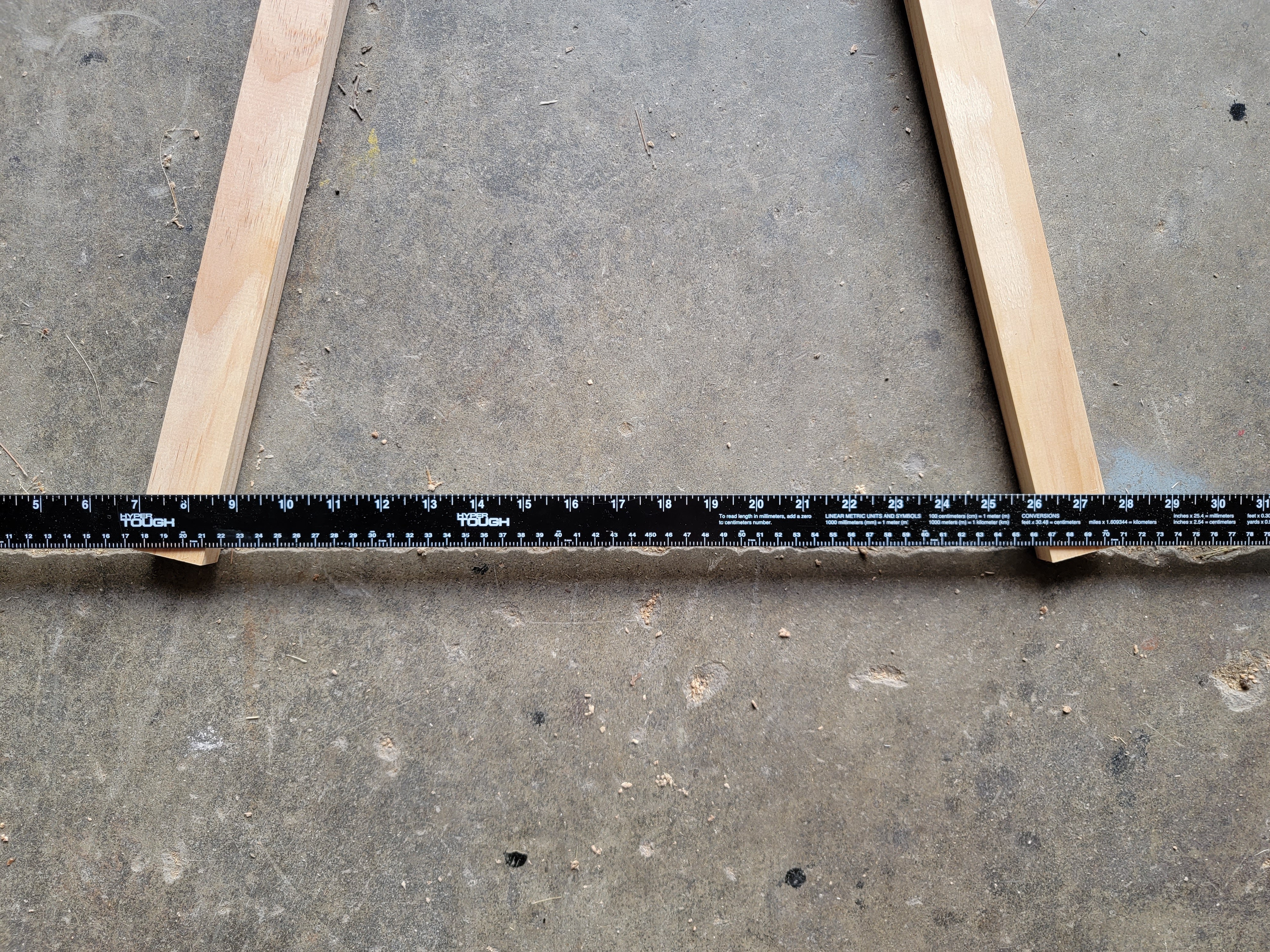
I laid two of the pieces on the ground and fiddled with the angle of teepee shape until it looked the way I wanted it to. Then I took a straight edge and ran it from tip to tip of the bottom outside corners.

I then took a pencil and traced along the straight edge. This marked a line that I needed to cut in order for the pieces to sit flush on the ground. Once the line was marked, I was able to use that + a right angle tool to determine the angle I wanted was 15 degrees.

I set my miter saw to make a 15 degree cut and trimmed off the edges on both the bottom and top of all four pieces, making sure the top and bottom of each piece were cut in the same direction.

Next, I took the pieces and got them back in the teepee shape I wanted and then used clamps to secure the wood to my workbench to make sure it didn’t budge. I also took my pencil and lightly traced along both edges of the piece on top, so just in case the boards did slip, I could easily line them back up again.

I marked the center of the wood overlap (for me, it was 8 inches down from the top of the wood) and used a 3/32″ drill bit to drill a small pilot hole all the way through.

I then used a wood screw (size 9 x 2 1/2) and a star bit on my power drill to attach the two pieces together.

I flipped the pieces over, re-clamped them (the line I traced came in handy for making sure they were back at the right angle!), and then measured out a scrap piece of wood for the bottom shelf. I wanted the bottom of the shelf support to be five inches off the ground, so I measured and cut a piece of scrap wood to fit. I trimmed off the edges at 15 degrees so it would run flush with the side pieces and I attached the support to the side pieces using a nail gun and 1 inch nails.

I repeated those steps until I had two identical side pieces. (Side note: I now wish I had made them mirror images of each other instead of identical. It doesn’t change anything structurally, but just aesthetically I think I would have preferred that look)

Next up was the bottom shelf. I took pine boards (7/16 x 4 1/2 x 8) and cut them down to my desired shelf length: 30 inches.

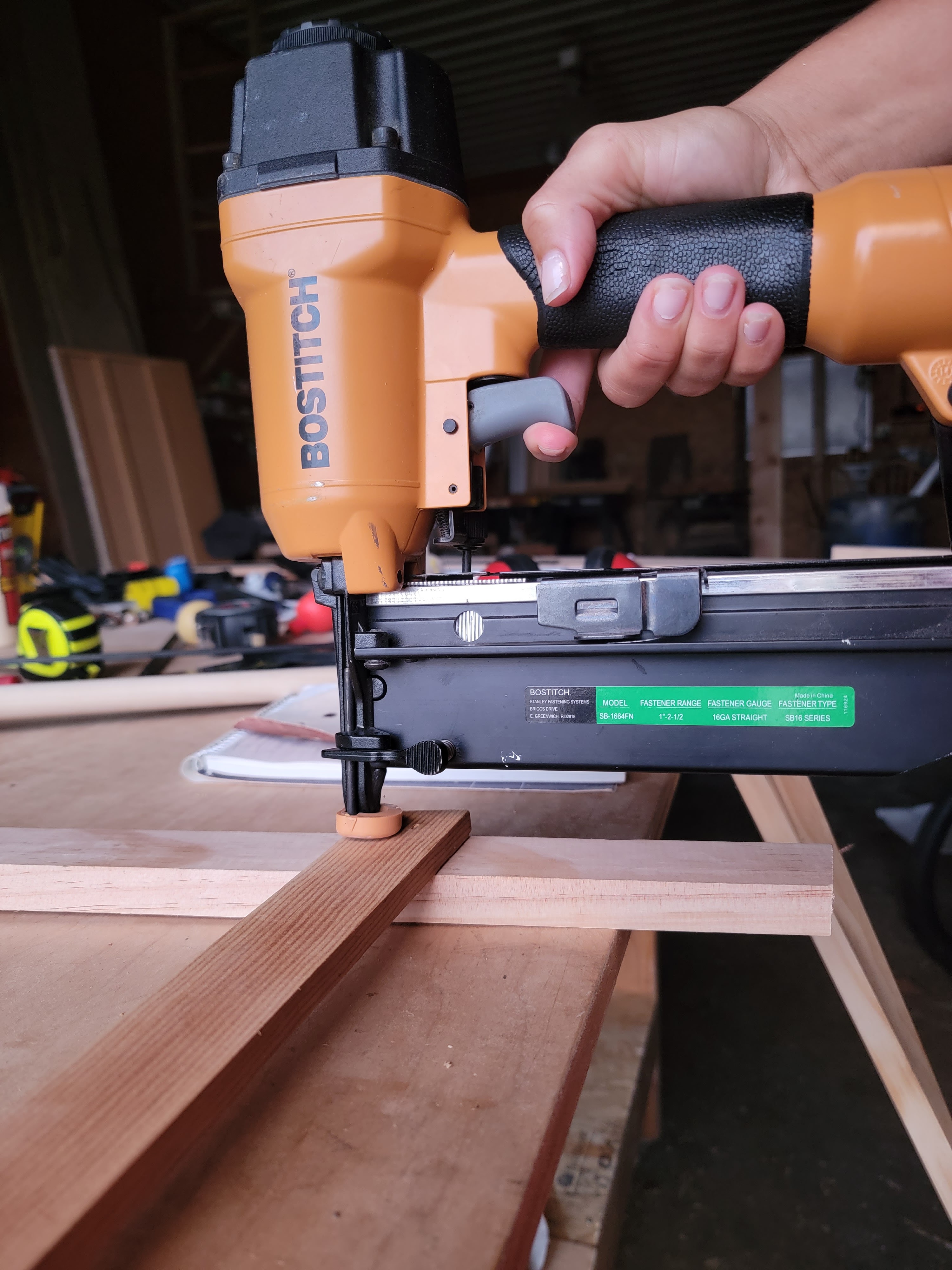
I used my nail gun and 1 inch nails to nail down each shelf into the shelf support. Four boards fit perfectly across! I wanted a little extra support in the middle since the shelf was pretty long so I got a piece of sturdy scrap wood and nailed it to the center of the bottom of the shelves.

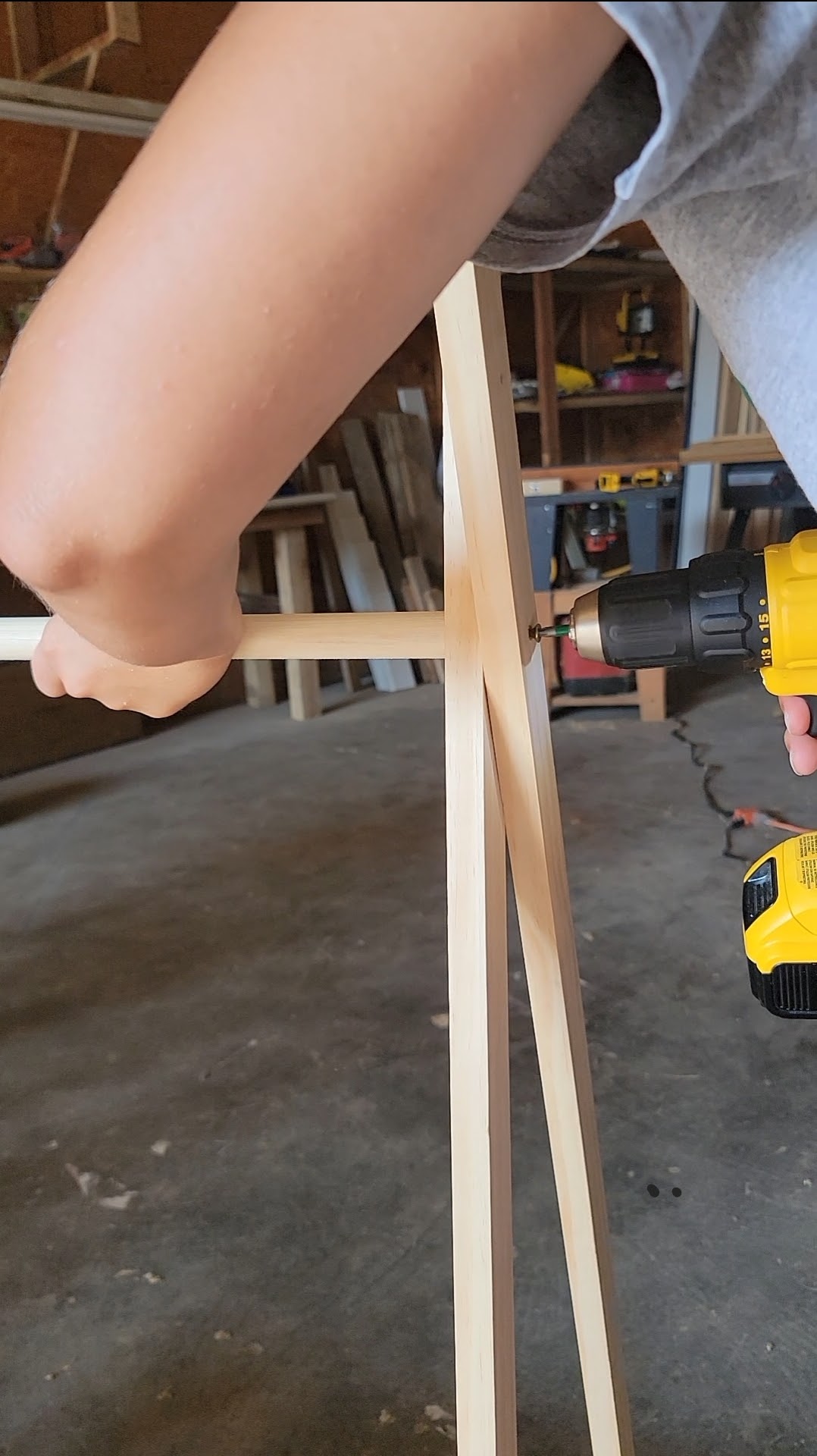
Last up was attaching the dowel rod. Remember the wood screws I used to attach the criss-crossed part at the top? These actually went all the way through the wood and stuck out the other side. I measured from screw to screw across the top and cut the dowel rod to length (because of the way the wood overlapped, it was not the same length as the bottom shelf boards!)

I used my power drill to reverse the screw out until it was no longer visible on the inner part of the teepee, then held the dowel rod tightly up against the 1×2 and drove the screw back in. I recommend using a small level to make sure that your dowel rod is going straight across!

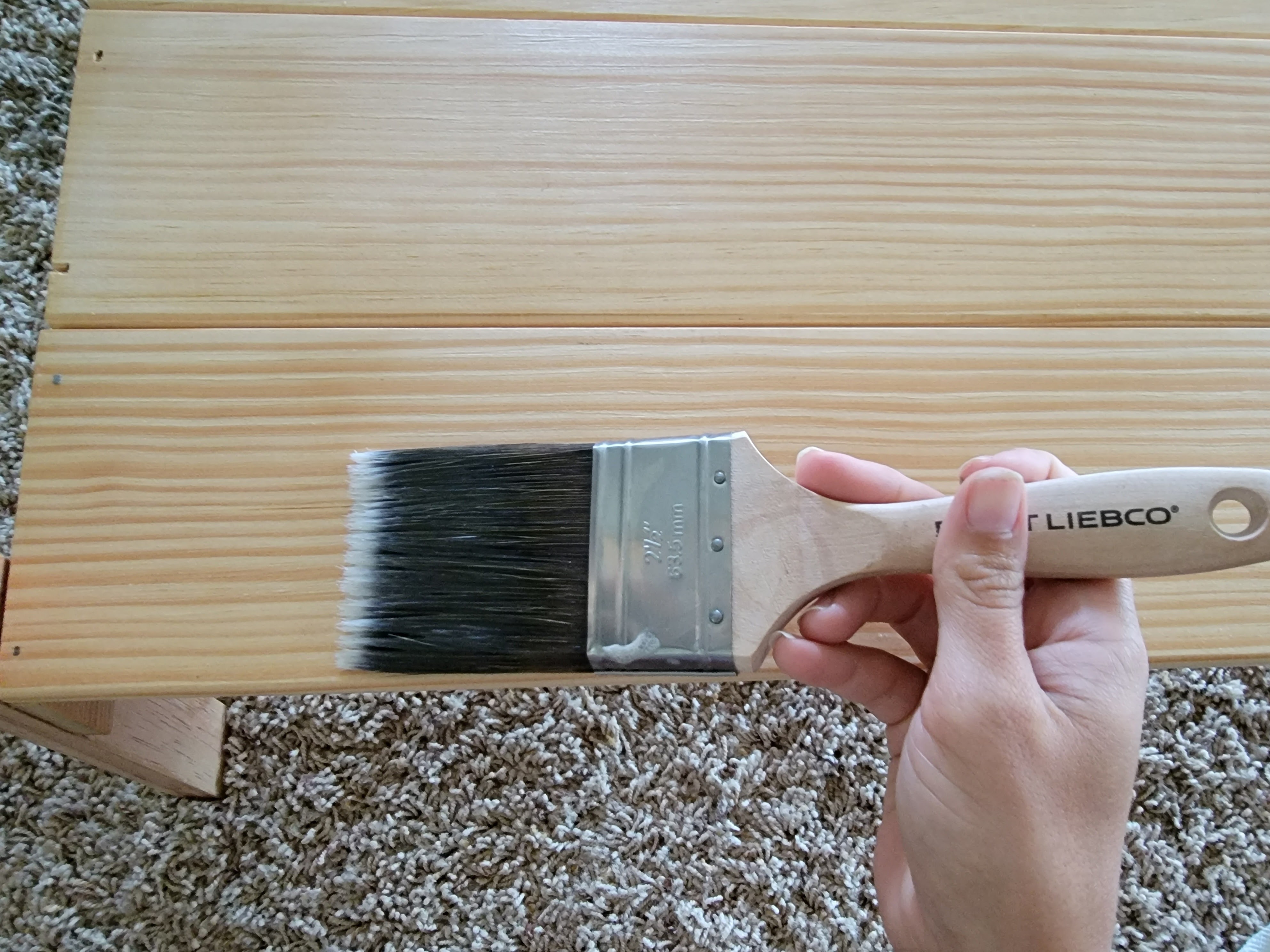
I then took some sandpaper (first 80 grit, then 220 grit) and sanded down any rough areas. I wiped it down with tack cloth and applied two coats of a clear matte polyurethane (giving it a light sand with 400 sandpaper in between coats).

I’m really pleased with how this turned out and I know Violet is going to love it. I can’t wait to see it full of fun dress up clothes after her party tomorrow! This little clothing rack is about to get lots and lots of fun use!

Staining an Ikea Hemnes Dresser Black!

When I was searching for dresser ideas for my primary bedroom renovation, I came across this dresser and it stopped me in my tracks:

I loved so much about this dresser: the clean lines, the black stain, the subtle wood grain, the leather drawer pulls. Really the only thing about it I didn’t like was the price. Yikes! At first I considered building my own dresser to mimic this one, but thankfully I was talked out of that. Instead, I decided to take a basic Ikea Hemnes dresser and recreate this look for a tiny fraction of the cost.

The Hemnes does come in a black-brown stain but it was out of stock so I bought it in a gray stain. At first, I covered it with a coat of paint in Sherwin Williams Tricorn Black, but I did not like the way it turned out at all. It looked like, well, a cheap dresser that was painted. Luckily, the latex paint sanded off very easily and I was able to start over with a different plan. Here’s what I did:

Materials

-Ikea Hemnes Dresser

-Orbital Sander + 80 grit and 120 grit sandpaper

-Plastic Wood

latex gloves

Black Stain

-Foam Brushes

-Clean, dry cloth

Painters Tape

Brown Stain

Polycrylic

Synthetic Bristle Brush

Tack Cloth

-220 or 400-grit sandpaper

The first thing I needed to do was sand off the old gray stain. By far, this was the step that took the longest! I used an orbital sander and 80-grit sandpaper to get most of the stain off, then I went over the whole thing again with 120-grit sandpaper to smooth the coarse surface.

Before sanding down the drawer fronts, I filled in each of the drawer pull holes with plastic wood. This product only takes about 15 minutes to dry and then you can sand and stain it just like the rest of the wood.

You can see that there are still some traces of gray stain left on the dresser above. I decided to save myself the time and effort of removing every tiny bit because I knew that the black would cover it up without anyone being able to tell it was there.

After everything was sanded with both grits of sandpaper, I wiped down every surface with a tack cloth to collect all the dust. I also used painter’s tape to tape off the bottom of the legs (making the top of the tape line even with the bottom of the dresser body) because I wanted to stain that part a different color. More on that later!

I tested out a few black stains and settled on this water-based solid color stain. I used a foam brush to apply the stain in long strokes, making sure to follow the direction of the wood grain. I like to wear latex gloves when staining to protect my hands.

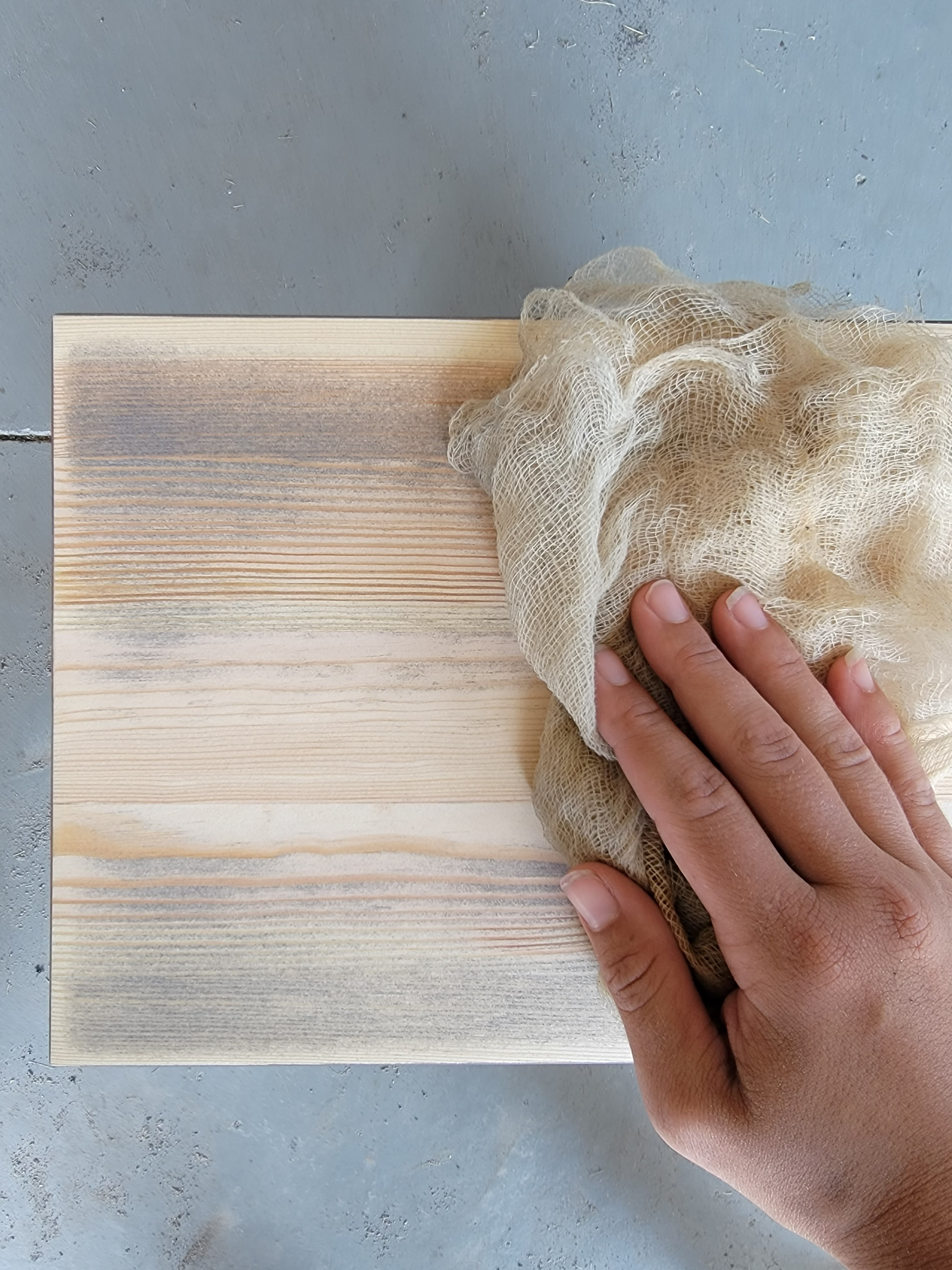
This stain is thick and absorbs pretty quickly so I worked in small sections and wiped the excess stain off with a clean, dry scrap cloth.

You can see above what the wood looked like after one coat of coverage. I wanted to see less of the wood grain, so after letting the surfaces dry for about 2 hours, I reapplied a second thin coat of stain on top using the same process as before, except working in smaller sections so I could wipe the stain off a little quicker (thus, keeping it from penetrating too much and getting too dark). Here’s a good comparison of what one coat vs. two looked like:

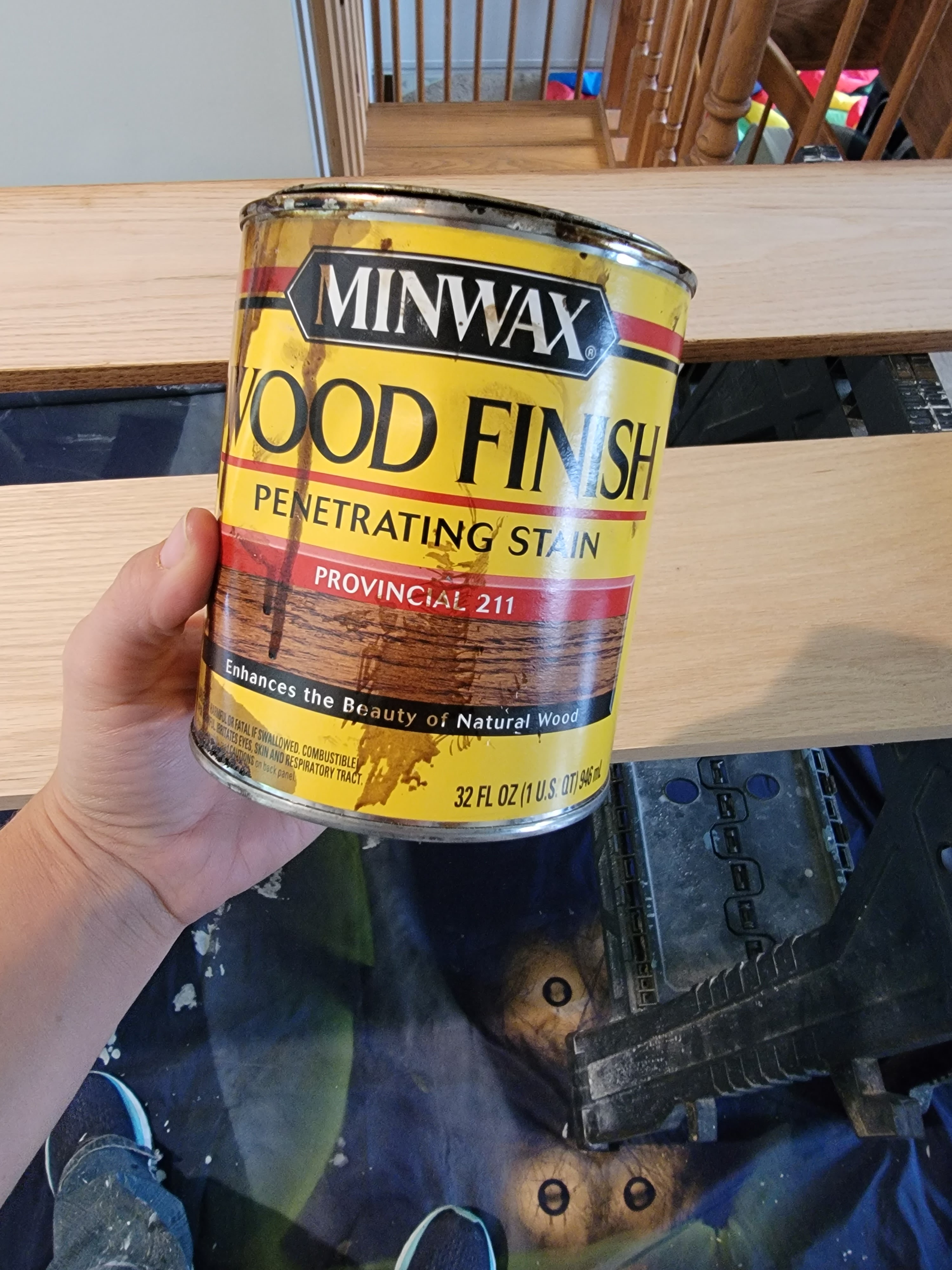
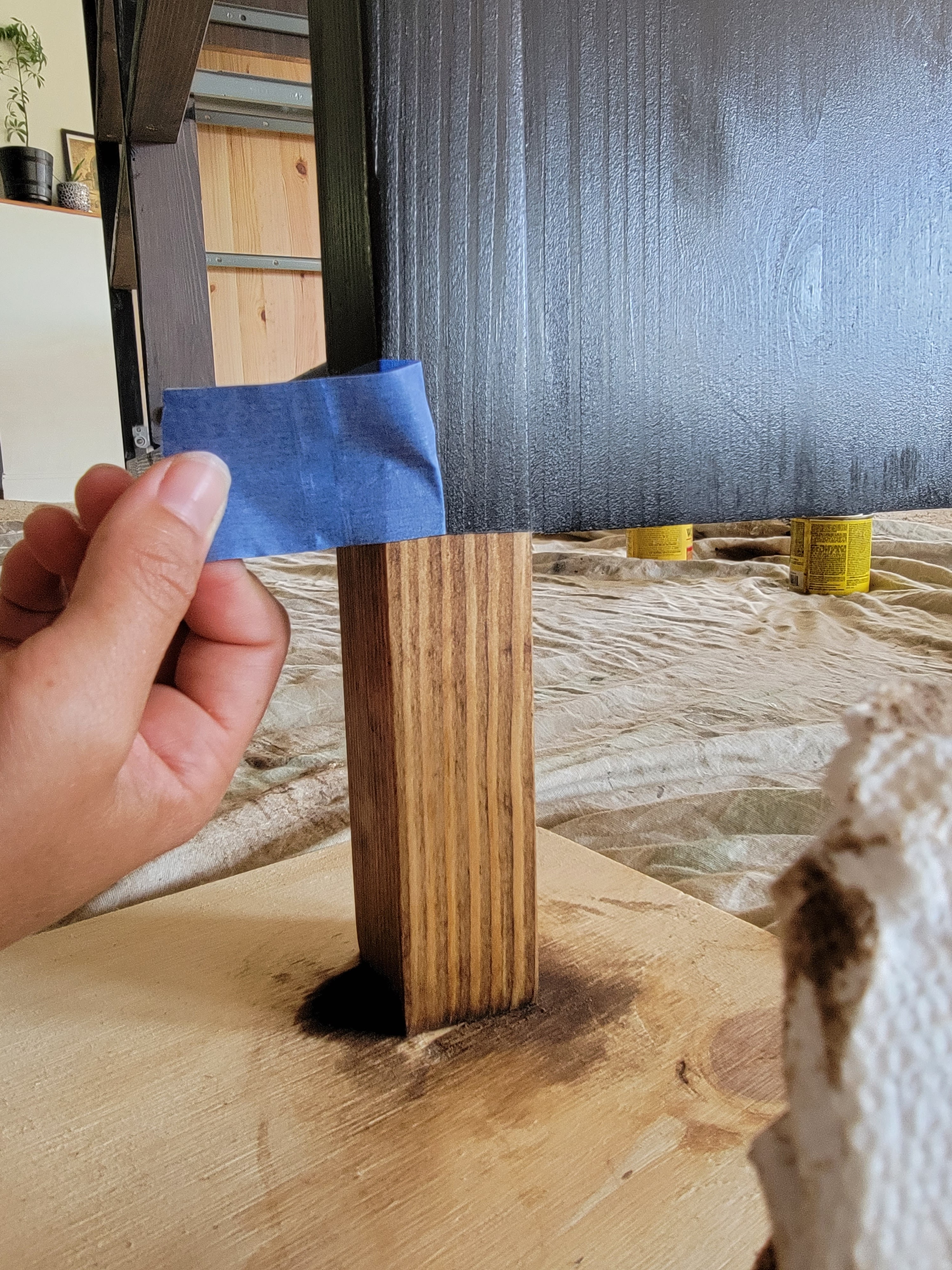
After all the black stain dried, it was time for the bottom of the legs. I tore off the painter’s tape at the bottom of the legs and put new tape that lined up with the bottom of the black stain (note: for the bottom of the legs, I made sure to sand away all of the previous gray stain). I had a bunch of random stains leftover from previous projects and after testing them out, I settled on this provincial.

I set the legs on top of scrap wood so I could get all the way to the bottom without ruining the floor. I didn’t want the stain to be too dark so I applied a light coat of stain with a foam brush and wiped it off almost immediately. Then I removed the tape – I love a nice, crisp line!

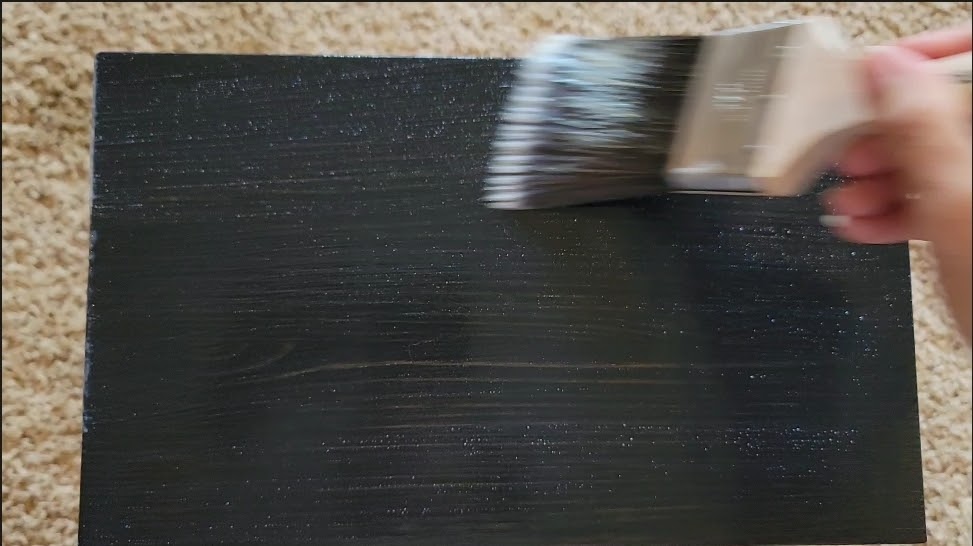
After the provincial stain dried, the dresser was ready for topcoat. I chose this Polycrylic Protective Finish in a clear matte finish. After carefully stirring, I used a new synthetic bristle brush to apply a thick layer in long strokes, again following the direction of the wood grain.

Polycrylic looks white and bubbly when first applied. It dries clear, but the bubbles do leave a slight amount of a textured feel. After letting the first coat dry, I used a 400-grit sandpaper to very lightly (seriously, hardly any pressure is needed!) sand the surface smooth again.

After sanding the dresser and drawer fronts, I wiped everything down with a clean tack cloth and then repeated another round of Polycrylic + light sand + tack cloth. Once everything completely dried, I could pop the drawer back in and admire the (almost) finished result!

Even though I’m still waiting on the new drawer pulls to come in, I am so so thrilled with how this dresser is turning out. The picture truly doesn’t do it justice. It looks so chic! It has the same clean lines look and subtle wood grain that my inspiration dresser had and I love the added character from the stained legs. It definitely looks like a higher-end product and I’m so glad I went with my gut on re-staining this one!

ORC Week Three: Fabric Sample to the Rescue!

Another week of the One Room Challenge has come and gone and if this one was a Friends episode, it would be titled The One Where Almost Nothing Happened. Ha! I say “almost” because one very small but important thing did happen yesterday afternoon, in the final hours of a week full of no other progress.

ORC-Guest-400x218.png

When I first ordered my bed, the estimated delivery date was May 14. Then I got a notice that it would be May 17. Than I got another notice that it was backordered and wouldn’t arrive until May 25. I’m crossing my fingers that that will be the actual date of arrival but at this point, I’m not very confident.

Unfortunately, our bedroom has more or less been at a standstill with the delay of the bed. I had been waiting on it before making decisions with other colors, textures, and textiles to bring into the room so it’s been very frustrating to not know when it’s going to arrive. Then last Saturday, I realized that I could order a fabric sample of the upholstery! I immediately ordered a free sample, only to have it tell me the estimated delivery date was June 15. Sigh.

I ordered it anyways, thinking maybe it would still come before the bed. I’m so glad I did because it completely surprised me by arriving yesterday! Although the order on the website still says “preparing for shipping” with a delivery date of June 14 so that really doesn’t give me confidence in Wayfair’s delivery notifications. Hopefully that’s not a bad omen for the bed’s shipping…

Now that I at least have the fabric sample, I feel like I can actually proceed with making some other decisions. I’m feeling energetic and excited to get moving on this again!

Make sure to check out the other ORC participants here. They probably have made a bit more progress than I did this week. šŸ˜‰